In mid-1985, Intel was losing money on memory chips, the product it was founded on. Andy Grove, then president, later described talking it over with CEO Gordon Moore: “I turned back to Gordon and I asked, ‘If we got kicked out and the board brought in a new CEO, what do you think he would do?’ Gordon answered without hesitation, ‘He would get us out of memories.’”
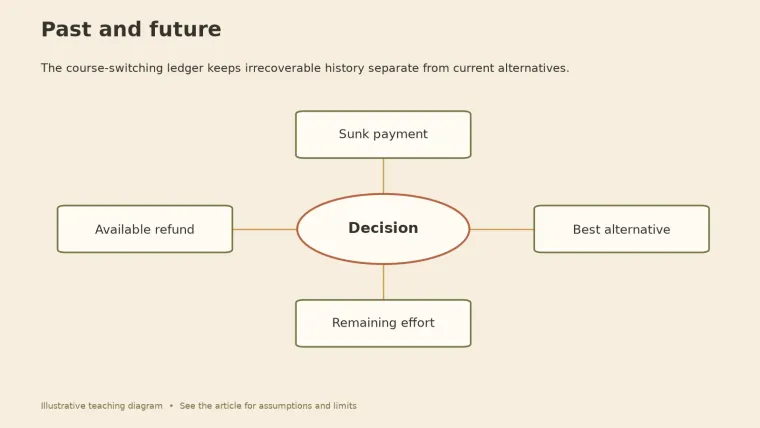
Sunk cost fallacy vs opportunity cost comes down to two questions: what can you no longer recover, and what are you giving up right now? A sunk cost is already spent and cannot be recovered. The fallacy lets it steer a current choice. Opportunity cost is the value of the best alternative you forgo by choosing.
Intel’s new-CEO question split the past from the future
Grove’s next line, quoted in Commoncog’s case study of the exit, was: “Why shouldn’t you and I walk out the door, come back and do it ourselves?”
The history was heavy. Intel had launched its 1103 DRAM in 1970, and the company timeline calls DRAM one of its first major innovations. Grove called the exit “an emotional decision. We had been the first to introduce the product and build the business.” Fifteen years of research, pride, and identity could not be recovered by staying in. That was the sunk cost.
The opportunity cost was sitting in the factories. Every wafer run spent on money-losing memory was a run unavailable for microprocessors. Intel’s middle managers had already noticed. Grove wrote that by the time of the exit decision, only one of the company’s eight silicon fabrication plants was still producing memories, because managers had been shifting capacity toward more profitable lines.
The imaginary new CEO had no history to justify. He could only compare the options still open. The exit took until mid-1986 to carry out. Grove later said, “In retrospect, getting out of DRAMs when we did was the best business decision we ever made.”
| Intel in 1985 | Sunk or relevant? | Why |
|---|---|---|
| Fifteen years of memory R&D | Sunk | Spent either way; staying cannot earn it back |
| Being “the memory company” | Sunk, but emotionally loud | Identity is history, and it argued for staying |
| Factory capacity | Relevant | It could make memories or microprocessors next quarter |
| Engineers and process skills | Relevant | Reusable for the new product line |
| Profit per wafer by product | Relevant | Compares the alternatives still available |
The two ideas side by side
| Question | Sunk cost | Opportunity cost |
|---|---|---|
| Time direction | A cost already incurred | A value forgone through a current choice |
| Key condition | It cannot be recovered through today’s decision | The alternative is available and next best |
| Intel example | Years of memory investment | Microprocessor output the fabs could produce instead |
| Role in the present comparison | Does not change across the relevant options | Helps compare competing uses of a resource |
A sunk cost is a property of a cost; the fallacy is a mistake in reasoning about it. OpenStax frames the relevant forgone use as the next best alternative.
The same ledger on a personal scale
You paid $300 for a course with no refund. Four evenings remain. A free workshop would use the same evenings and fits one of your current goals better. The amounts are hypothetical.
| Ledger item | Category | How to treat it |
|---|---|---|
| $300 already paid with no refund | Sunk cost | The same past payment under either choice |
| Four remaining evenings | Future scarce resource | Compare what each use provides |
| Remaining course material | Potential future benefit | Assess whether it still serves the goal |
| Alternative workshop | Feasible alternative | Assess its relevant net benefit |
| Time needed to switch | Future switching cost | Include if it would actually be incurred |
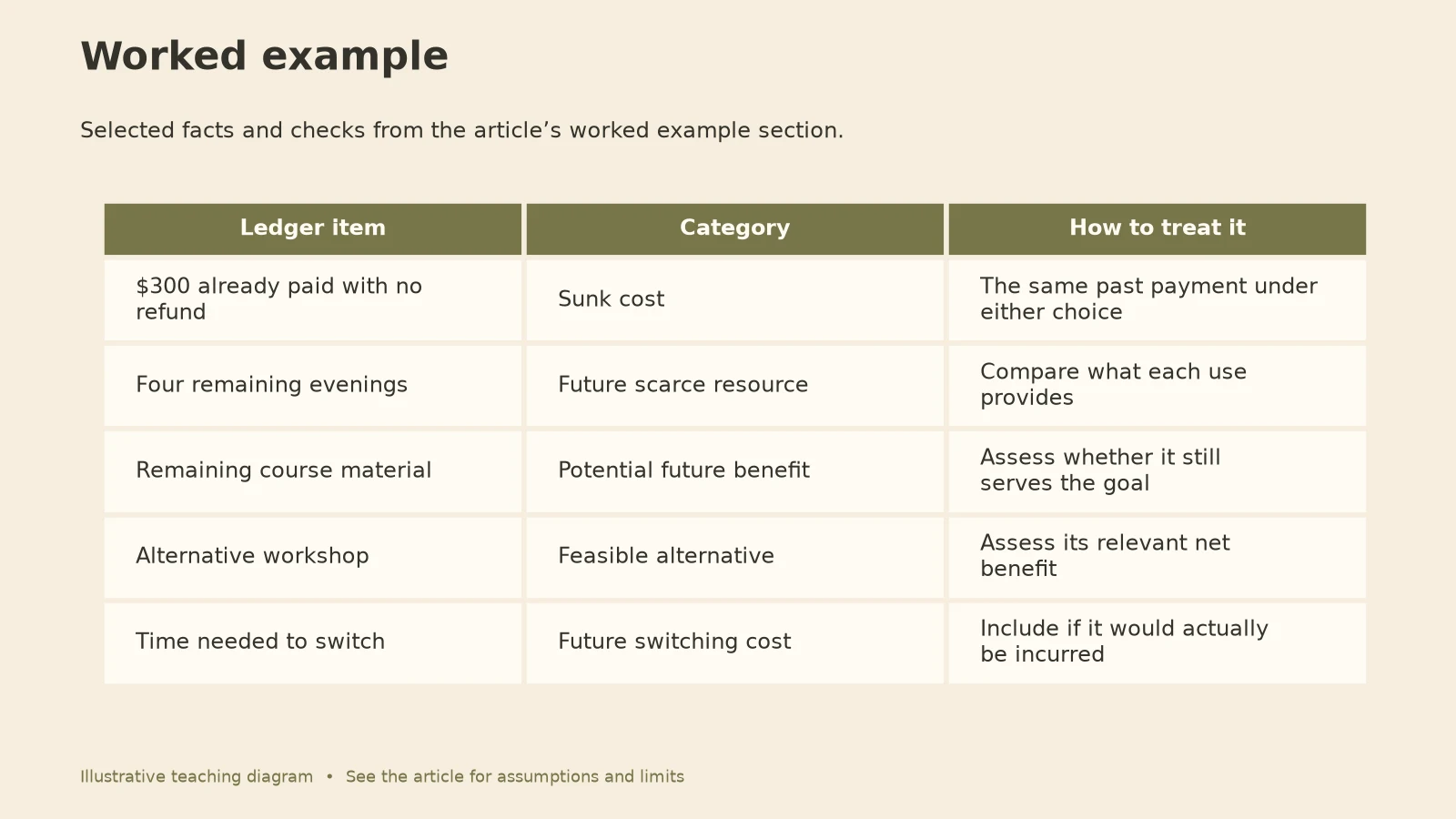
If you stay, the opportunity cost is the value of the workshop you give up, not the $300 already paid. The ledger does not prove switching is better, since the remaining material may be valuable. Ask Grove’s question in personal form: “If I were starting fresh tonight, which option would I pick?”
Not everything in the past is sunk
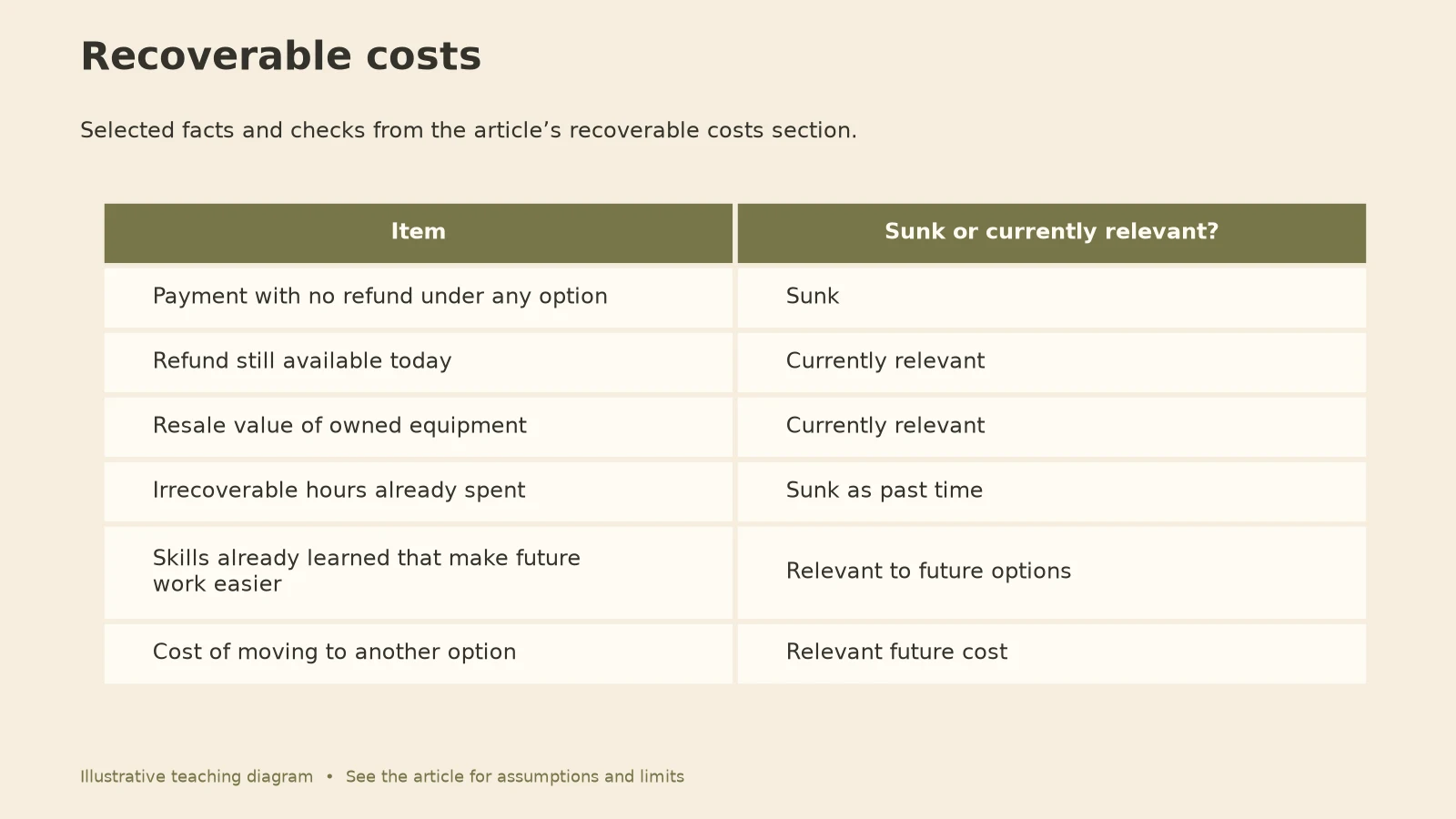
Change one fact. If a $100 refund is still available if you leave today, that money depends on the current decision, so it belongs in the comparison. Intel’s factories worked the same way: built in the past, but still able to produce something new.
| Item | Sunk or currently relevant? |
|---|---|
| Payment with no refund under any option | Sunk |
| Refund still available today | Currently relevant |
| Resale value of owned equipment | Currently relevant |
| Irrecoverable hours already spent | Sunk as past time |
| Skills already learned that make future work easier | Relevant to future options |
| Cost of moving to another option | Relevant future cost |
Also avoid counting the same refund or switching cost twice.
Decision checklist
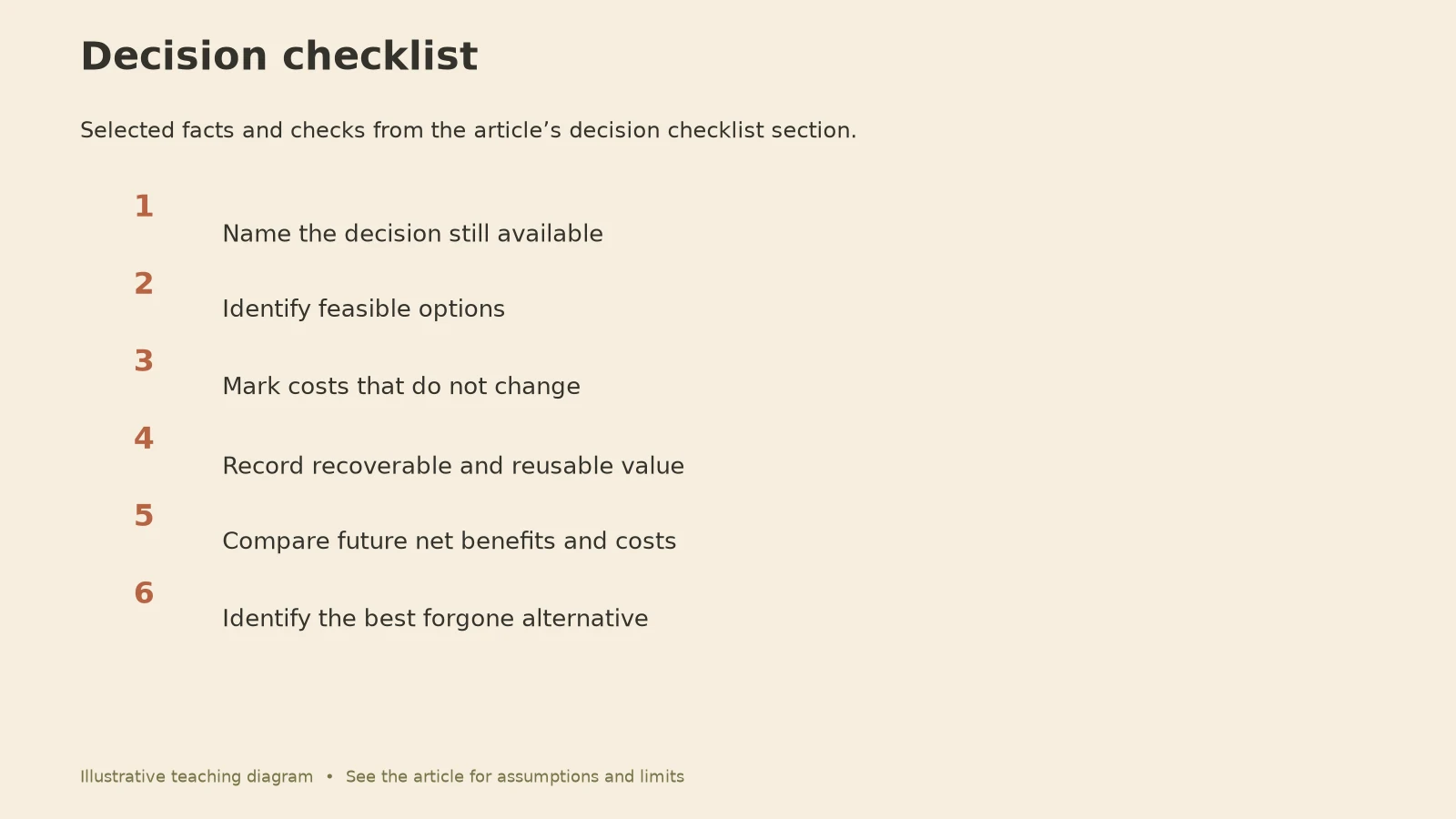
- Name the decision still available. Do not frame an irreversible past payment as though you can now choose whether to incur it.
- Identify feasible options. Include continuing, modifying, stopping, or switching where they are genuinely available.
- Mark costs that do not change. Explain why they are unrecoverable.
- Record recoverable and reusable value. Keep refunds, resale, transferable work, and relevant knowledge visible.
- Compare future net benefits and costs. Use consistent units and avoid false precision.
- Identify the best forgone alternative. This is the opportunity-cost question.
Finish by noting which new fact would change your answer. When the numbers can be compared, the opportunity cost formula guide shows the arithmetic, and trade-off vs opportunity cost separates a compromise from the value of the best alternative.
When the sunk-cost lens backfires
Treating all history as irrelevant. Intel’s fabs and engineers were past investments that still had value. Writing them off would have been its own mistake.
Trusting the fresh-start question too much. An imagined newcomer can be overconfident too. Grove’s question cleared away the history but guaranteed nothing; Intel was helped by its 386 processor selling well.
For a deeper test of when to continue, see the sunk cost fallacy. For choices with several criteria, use decision-making frameworks.
Questions
Are sunk costs always irrelevant?
An irrecoverable cost does not change across today’s options. But past work can create current capabilities, obligations, or recoverable value. Identify those effects separately instead of dismissing all history.
Is quitting always the rational choice?
No. Continuing can have the best future value. The problem is continuing solely to justify an unrecoverable cost.
Is the opportunity cost every option I rejected?
No. It is the value of the next best alternative you could actually choose. Adding incompatible alternatives creates a comparison with something you could never have had. For the basics, see opportunity cost.
Your 5-minute new-CEO check
Decision still open:
What I've already spent that I can't get back:
What I could still recover (refund / resale / reusable skill):
If a stranger took over tonight, they would:
Best alternative I give up by continuing:
Fact that would change my answer:
If the commitment is a routine, such as a training plan or a study schedule, take a prompt from Sweat and rebuild it around the next four weeks.