⚡ Short answer: paying attention means deliberately pointing your mind at one thing and accepting that everything else goes unwatched. It is a trainable skill, not a fixed trait — and in driving, aviation, and medicine it is treated as a safety-critical resource with rules, procedures, and hard numbers attached.
What Does ‘Paying Attention’ Really Mean?
We throw the phrase around constantly: “Pay attention!” a teacher scolds. “Thanks for paying attention,” a friend says. But what does it actually mean to pay attention?
At its core, paying attention means to watch, listen to, or think about something carefully or with interest. It’s not just about hearing words or seeing objects; it’s about actively engaging your mind with what’s in front of you.
Gordon Training International puts it more personally: paying attention means valuing yourself enough to give your thoughts, feelings, needs, ideas, goals, and aspirations your full attention. That’s a deeper take—it’s not just about external focus, but also about how you treat your own inner world.
In a learning context, the University of Southern Maine defines attention as focusing on what is being stated, discussed, or shown, using your senses to literally bring information into your brain. So when you’re in a meeting or a class, paying attention is the physical act of pulling information in through your eyes and ears and letting it register.
But here’s the catch: attention isn’t automatic. It takes effort. And in a world full of notifications, open tabs, and constant noise, that effort is harder than ever.
Why Do We Say ‘Pay’ Attention?
Have you ever wondered why we say “pay attention” instead of “give attention”? It’s a curious phrase. The word “pay” suggests a transaction, an exchange of something valuable.
According to language experts, the phrase likely comes from the idea that attention is a resource you spend. When you pay attention, you’re giving something of yourself—your time, your mental energy—in exchange for understanding or connection. It’s not a casual gift; it’s a deliberate investment.
This is a useful mental model. If attention is a currency, then every time you check your phone during a conversation, you’re spending that currency on something trivial. Every time you zone out during a lecture, you’re wasting it. The phrase reminds us that attention has value.
The word is older than the money metaphor, though. English took “attention” from Latin attendere in the late 14th century, and attendere literally means “to stretch toward” (Online Etymology Dictionary). The original picture is physical, not financial: you lean your mind in the direction of something. The word stayed rare in English until the 17th century, and the everyday sense of “observant care” only settled in around 1741.
Here is the part most explanations skip: English is unusual in making you pay. Its closest neighbours mostly lend attention instead — French prêter attention, Spanish prestar atención, Portuguese prestar atenção, Italian prestare attenzione. German gifts it: Aufmerksamkeit schenken. Chinese skips the transaction entirely; 注意 is closer to “aim your gaze at this”.
That matters, because the two metaphors predict different behaviour. Money is gone the moment you spend it, so the English phrase quietly suggests attention is a budget to guard. The lending version is closer to how attention actually behaves: you hand it out, it wears down, and it comes back after sleep, food, and breaks. If you take the loan metaphor seriously, the goal is not spending less attention — it is getting more of it repaid, which is why the strategies further down focus on recovery rather than thrift.
The Science of Attention: It’s a Skill, Not a Trait
Many people believe they’re just “bad at paying attention.” They think it’s a fixed personality trait, like being left-handed or having blue eyes. But research and experts disagree.
As the Harvard Gazette reports, attention is a skill that can be learned and improved. It’s like a muscle: the more you exercise it, the stronger it gets. And just like a muscle, it gets tired if you overuse it without rest.
This is good news. It means you’re not doomed to a life of distraction. You can train your brain to focus better, just like you’d train your body to run faster.
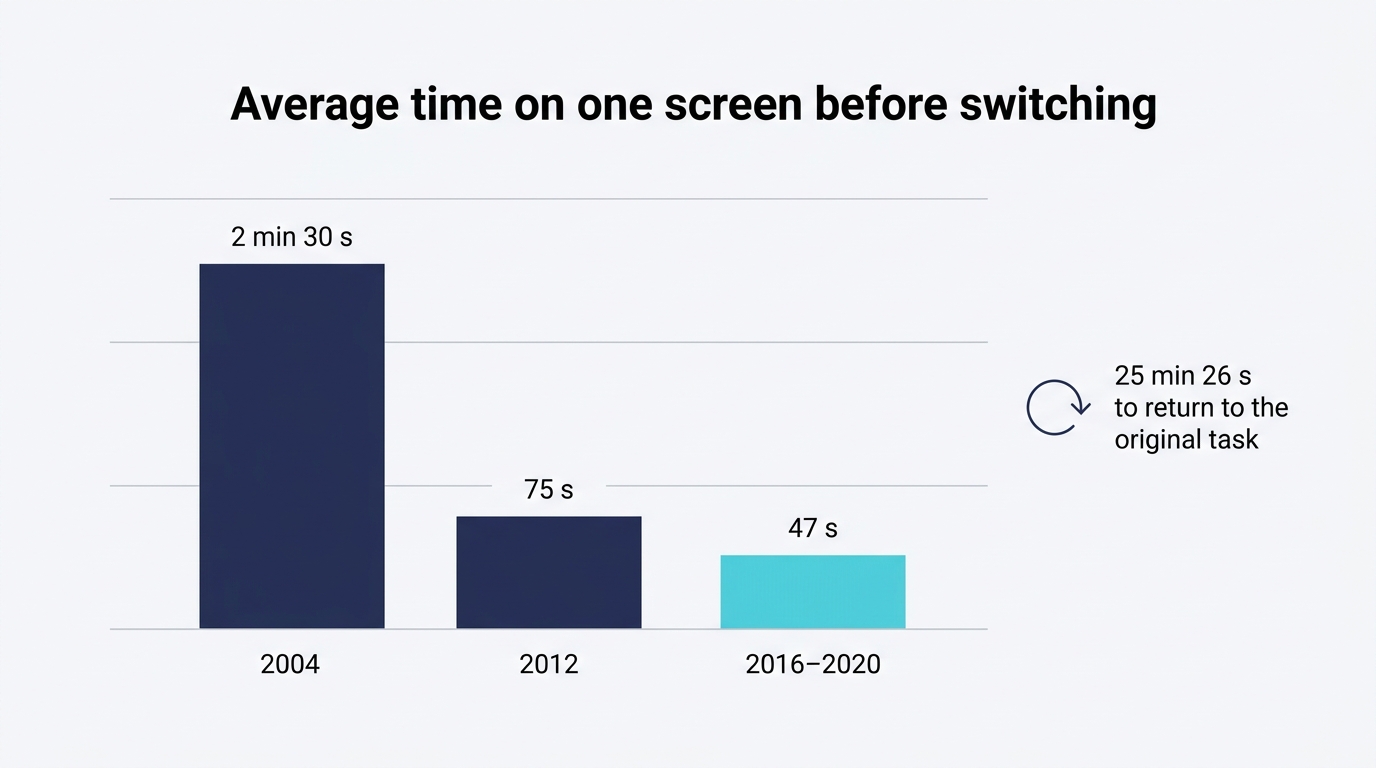
How much training does that take? More than most people assume. Gloria Mark, an informatics professor at UC Irvine who has logged real computer use for two decades, found that the average time someone stays on one screen before switching fell from 2 minutes 30 seconds in 2004 to about 75 seconds by 2012, and to 47 seconds in the years up to 2020 (University of California; American Psychological Association). The median was 40 seconds, so half of all observed attention spells were shorter than that. And once a work project gets interrupted, her data shows it takes 25 minutes and 26 seconds on average to come back to it.
Read those two numbers together and the arithmetic gets uncomfortable. If a typical stretch of focus is under a minute and the return trip costs 25 minutes, most people never finish paying attention to anything in a working day — they keep making down payments. Mark also found that roughly half of these interruptions are self-inflicted: nobody pinged us, we just reached for the phone.
But there’s a catch: attention takes effort. As one Reddit user in r/philosophy put it, “When our survival depends on paying attention we make the effort, when survival is easy we get lazy.” In modern life, survival is easy, so our attention naturally wanders. We have to consciously choose to bring it back.
The Two Sides of Attention: Focusing and Noticing
When we think of paying attention, we usually think of focusing on one thing—like reading a book or listening to a speaker. But attention has another side: noticing what you’re ignoring.
Narayan Pant, in his blog on getting to attention, makes a powerful point: paying attention requires noticing all thoughts—not just the loud ones. We often get so caught up in the obvious distractions (the ping of a text, the urge to check email) that we miss the quieter signals our mind is sending. Maybe you’re feeling anxious about a deadline, but you’re not paying attention to that feeling. Maybe you’re hungry, but you’re ignoring it.
True attention means being aware of the whole landscape of your mind, not just the spotlighted center.
This is where mindfulness comes in. A TEDx talk titled “Are you here right now? The surprising power of paying attention” suggests a simple exercise: become aware of the feeling of your back against the chair, and notice where your hands are placed. That’s what paying attention looks like—not some mystical state, but a grounded awareness of the present moment.
How ‘Paying Attention’ Is Used in the Real World
The phrase is not just self-help language. It works as a grammar pattern, a hiring requirement, a traffic law, a cockpit procedure, and a business model. Lining up those uses tells you more about what attention really is than any dictionary entry.
1. As an everyday phrase
| Phrase | What it actually asks for | Where you hear it |
|---|---|---|
| Pay attention to me | Drop whatever else you are doing | Home, classrooms |
| Pay attention to detail | Catch the small errors other people miss | Job ads, performance reviews |
| Attn: Maria Chen | Route this document to one named person | Letters, invoices, purchase orders |
| Attention! | Stop moving and face forward | Military drill, public announcements |
| Pay attention to the road | Keep eyes and mind on one safety-critical task | Driving lessons, road signs |
Two usage notes worth keeping: the phrase almost always takes to plus an object (“pay attention to the instructions”), and the past tense is paid, never “payed”.
2. At work: attention leaves residue
In workplaces, “pay attention” usually gets translated into “stop multitasking” — and there is a measurable reason why. Organisational researcher Sophie Leroy’s experiments, published in Organizational Behavior and Human Decision Processes in 2009, showed that when people switch from Task A to Task B, part of their thinking stays behind on Task A. She called it attention residue, and performance on the new task suffered because of it.
The detail that gets lost in retellings is the fix. Residue was worst when Task A was left unfinished with no time pressure. Being able to close the loop — or at least deciding when you will return to it — was what let people transition cleanly. So the practical version of “pay attention” at work is not “try harder on this”, it is “finish or park the previous thing first”.
3. On the road: attention written into law
Driving is where attention stops being a virtue and becomes a legal duty. In the United States, distraction-affected crashes killed 3,208 people in 2024, and in 2023 they killed 3,275 and injured an estimated 324,819 — about 8% of all traffic deaths that year (NHTSA).
The numbers behind the slogan are what make it stick:
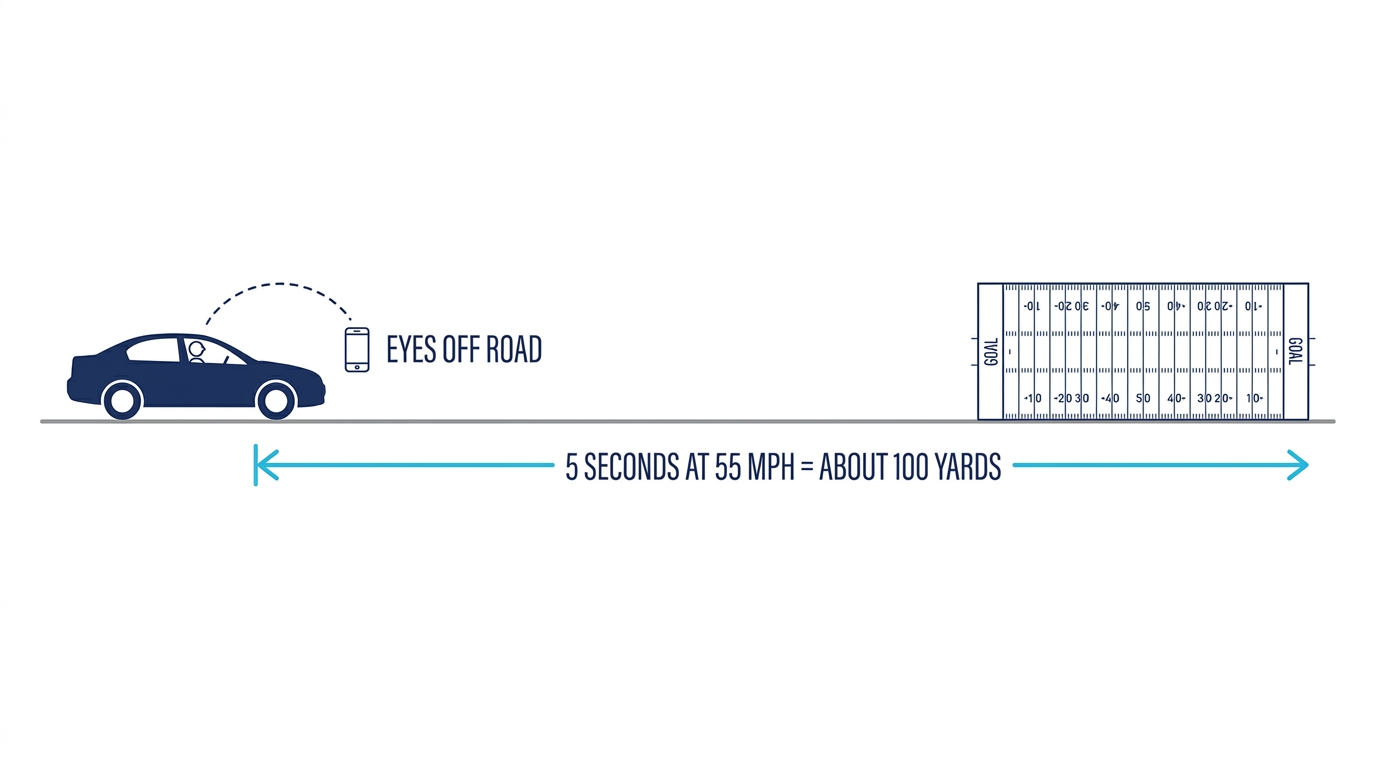
- Glancing at a phone for 5 seconds at 55 mph means covering roughly the length of a football field without seeing the road.
- Using a mobile phone while driving makes a crash about four times more likely, and the risk is similar for hands-free calls, because the problem is cognitive, not just manual (World Health Organization).
- Reaction times run about 50% slower while phoning, and texting raises crash risk far more sharply (Johns Hopkins Bloomberg School of Public Health).
4. In cockpits and reading rooms: attention as a procedure
Aviation went further and regulated conversation itself. Under the FAA’s “sterile cockpit” rule (14 CFR 121.542), crews may not engage in activities or chat unrelated to flight operations below 10,000 feet. A review of 63 relevant reports in NASA’s Aviation Safety Reporting System found that breaches lined up with 48% altitude deviations, 14% course deviations, and 14% runway transgressions.
Medicine shows the flip side: expertise does not buy immunity. In a 2013 study in Psychological Science, researchers hid a gorilla image — 48 times the size of an average lung nodule — inside a chest CT stack. Twenty of 24 radiologists (83%) never reported seeing it, and eye tracking showed that many of them had looked straight at it. All 25 untrained observers missed it too (study).
That is the uncomfortable half of the definition. Focused attention does not just leave gaps by accident; it creates them. Every time you pay attention to one thing well, you are buying blindness to everything you decided not to watch. “Pay attention” is never free advice — the only real question is what you are willing to stop seeing.
5. In the economy: someone else is collecting the payment
The transaction metaphor turned literal in 1971, when Nobel laureate Herbert Simon wrote that “a wealth of information creates a poverty of attention” in Designing Organizations for an Information-Rich World. He argued that designers kept solving for information scarcity when the real bottleneck was attention. That line became the foundation of what we now call the attention economy, and the United Nations now describes it in the same terms: supply of content keeps growing, while the attention available to consume it does not.
So when a feed is free, your attention is the payment. That is the same verb the teacher used, with a different party collecting.
6. What high-stakes settings do differently
Put those cases together and a pattern shows up that most advice about focus misses. Not one of these systems relies on people wanting it more. Aviation bans the small talk during the risky phase of flight. Road safety law removes the phone from the driver’s hand. Radiology leans on structured search routines and second readers rather than on individual willpower.
In other words, professionals do not try to be more attentive. They delete the competing demand, and only in the window where it matters most. You can copy the design directly: pick the one or two stretches of your day that are your “below 10,000 feet” — the report, the difficult conversation, the drive home — and make distraction structurally unavailable during them instead of resisting it moment by moment.
Why Is It So Hard to Pay Attention?
If attention is a skill, why does it feel so impossible sometimes? Here are a few common reasons:
- Your brain is wired for novelty. From an evolutionary standpoint, noticing new things (like a rustle in the bushes) was crucial for survival. Your brain is constantly scanning for something new, which makes it hard to stick with the same old task.
- You’re not getting enough rest. Attention requires energy. If you’re sleep-deprived, your brain doesn’t have the fuel to focus.
- You’re trying to multitask. When you think you’re multitasking, you’re actually just switching your attention rapidly between tasks. This drains your mental resources and makes you worse at everything.
- You’re not interested. Let’s be honest: it’s easier to pay attention to something you care about. If you find a topic boring, your brain will naturally wander.
- You’re stressed. Anxiety and stress hijack your attention, making you focus on worries instead of the present.
How to Pay Attention: Practical Strategies
So how do you get better at paying attention? Here are evidence-backed strategies from experts:
1. Use Physical Anchors
When you feel your mind drifting, bring your attention back to your body. Feel your feet on the floor. Notice the weight of your body in the chair. This simple act can ground you in the present and pull you out of your head.
2. Practice Attention Training Exercises
Chris Guillebeau, author and blogger, suggests trying attention training exercises like journaling, deep reading, or anything that requires your full attention. These activities force you to focus for extended periods, strengthening your attention span over time.
Try this: set a timer for 10 minutes and read a book without checking your phone. Or write in a journal about your day, paying attention to the details. These small practices build your mental muscle.
3. Notice All Thoughts, Not Just the Loud Ones
As Narayan Pant advises, make a habit of checking in with yourself throughout the day. What are you thinking? What are you feeling? Don’t just focus on the obvious distractions; notice the subtle ones too. This self-awareness is the foundation of attention.
4. Single-Task, Don’t Multi-Task
When you’re doing something important, give it your full attention. Close other tabs, put your phone in another room, and focus on one thing at a time. You’ll get more done and do it better.
One refinement, based on the attention-residue findings above: before you switch, spend 30 seconds writing down where you stopped and when you will pick it up. An unfinished task with no plan is the version that keeps pulling at you.
5. Take Breaks
Attention is a limited resource. Just like you can’t run a marathon without stopping, you can’t focus for hours on end without a break. Use techniques like the Pomodoro Method: work for 25 minutes, then take a 5-minute break. This gives your brain time to recharge.
6. Value Yourself Enough to Pay Attention
Remember the Gordon Training definition: paying attention means valuing yourself. When you give your full attention to a task, you’re respecting your own time and abilities. When you listen fully to someone, you’re valuing them. This mindset shift can make attention feel less like a chore and more like an act of self-care.
Common Mistakes to Avoid
Even with the best intentions, we often fall into traps that sabotage our attention. Here are some to watch out for:
- Trying to do it all at once. You can’t pay attention to everything. Accept that you have to choose where to focus.
- Feeling guilty when you get distracted. Distraction is normal. The key is to notice it and gently bring your attention back, not to beat yourself up.
- Ignoring your physical needs. If you’re hungry, tired, or uncomfortable, you won’t be able to focus. Take care of your body first.
- Confusing ‘paying attention’ with ‘looking like you’re paying attention.’ Nodding and making eye contact isn’t the same as actually listening. Real attention is an internal state, not an external performance.
The Power of Paying Attention to Others
Paying attention isn’t just about work or studying. It’s also about relationships. When you truly pay attention to someone—when you listen without interrupting, when you notice their mood, when you remember what they said—you make them feel valued.
In a world where everyone is distracted, giving someone your full attention is a rare gift. It can strengthen friendships, improve teamwork, and even resolve conflicts.
Putting It All Together: A Simple Attention Workout
If you want to improve your attention, start small. Here’s a simple daily routine:
- Morning check-in (2 minutes): Before you pick up your phone, sit quietly and notice your breath. Pay attention to how your body feels.
- Deep work block (25 minutes): Choose one task and give it your full attention. Turn off notifications. If your mind wanders, gently bring it back.
- Mindful listening (during a conversation): When someone is talking to you, resist the urge to think about what you’ll say next. Just listen.
- Evening journal (5 minutes): Write about your day. Pay attention to the details—what you saw, heard, felt.
Over time, these practices will strengthen your attention muscle, making it easier to focus when it matters.
Frequently Asked Questions
What does paying attention mean?
Paying attention means to watch, listen to, or think about something carefully or with interest. It involves actively engaging your mind with what you’re focusing on, rather than passively letting information wash over you.
What is a word for paying attention?
Synonyms include attentive, heedful, thoughtful, alert, aware, and observant. If you’re looking for a noun, attention, heed, or notice work well.
Do you say paid attention or payed attention?
The correct form is “paid attention.” “Payed” is only used in nautical contexts (like paying out a rope). So always say “I paid attention” in the past tense.
What helps with paying attention?
Strategies include minimizing distractions, taking breaks, practicing mindfulness, getting enough sleep, and doing attention-training exercises like journaling or deep reading.
Why do we say “pay attention” rather than “give attention”?
The phrase likely comes from the idea that attention is a resource you spend or invest. When you pay attention, you’re giving something of value—your time and mental energy—in exchange for understanding.
How do you know someone is paying attention?
Signs include maintaining eye contact, asking relevant questions, responding appropriately, and remembering what was said later. But true attention is internal, so it’s not always obvious from the outside.
What do you call someone who is paying attention?
You might call them attentive, focused, alert, or observant. In a more formal sense, they could be described as heedful or mindful.
How do you use “pay attention” in a sentence?
It normally takes to plus an object: “Pay attention to the instructions before you start.” You can also use it on its own as a command (“Pay attention!”), or in the past tense (“I paid attention during the briefing”).
What does “Attn:” mean on a letter or invoice?
“Attn:” is short for “attention” and directs a document to a specific person inside an organisation — for example, “Attn: Accounts Payable”. It is one of the oldest everyday business uses of the word.
Do other languages also say “pay” attention?
Mostly not. French, Spanish, Portuguese, and Italian all lend attention (prêter attention, prestar atención), German gifts it (Aufmerksamkeit schenken), and Chinese uses 注意, which is closer to “aim your gaze”. The payment metaphor is an English habit rather than a universal one.
Conclusion: Attention Is a Choice
Paying attention is more than just a phrase we use to scold distracted kids. It’s a fundamental skill that shapes how we learn, work, and connect with others. And the good news is, it’s a skill you can improve.
Start small. Notice when your mind wanders. Bring it back. Practice focusing on one thing at a time. And remember: every time you pay attention, you’re investing in yourself.
So the next time you catch yourself drifting, don’t get frustrated. Just say to yourself, “Pay attention.” And do it.