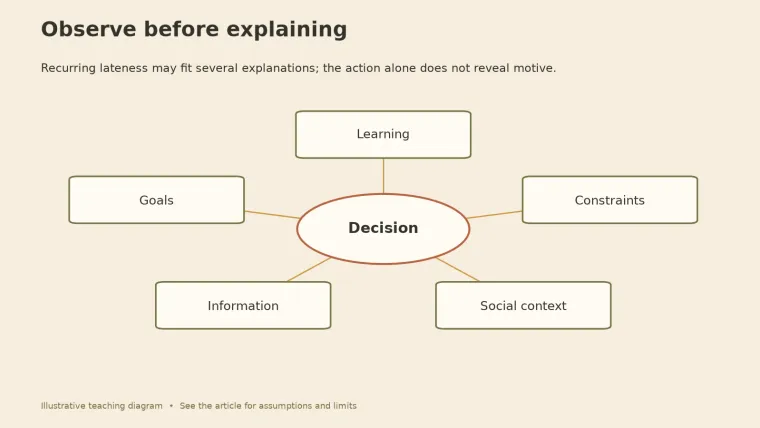
Human behavior is what people do, shaped by interacting influences such as learning, goals, emotions, social expectations, available information, and practical constraints. The same visible action can have several explanations. Someone arriving late might face a schedule conflict, misunderstand a time, or respond to a different priority; the action alone does not reveal a motive or a diagnosis. To understand a recurring behavior, describe it precisely, observe its context, compare plausible explanations, and identify what evidence could distinguish them. Use the result to choose a proportionate next step rather than reduce a person to a label.
Definition
OpenStax defines psychology as the scientific study of mind and behavior. Studying behavior therefore involves evidence and methods, not simply a confident story about why someone acts a certain way.
An observation describes what happened. An interpretation proposes what it means. “A participant arrived after the start on three recorded occasions” is an observation if the records are accurate. “They do not respect the group” is an interpretation.
The distinction matters because the same observation can fit several explanations. A useful account should make a testable difference to what you expect to observe next.
Influences
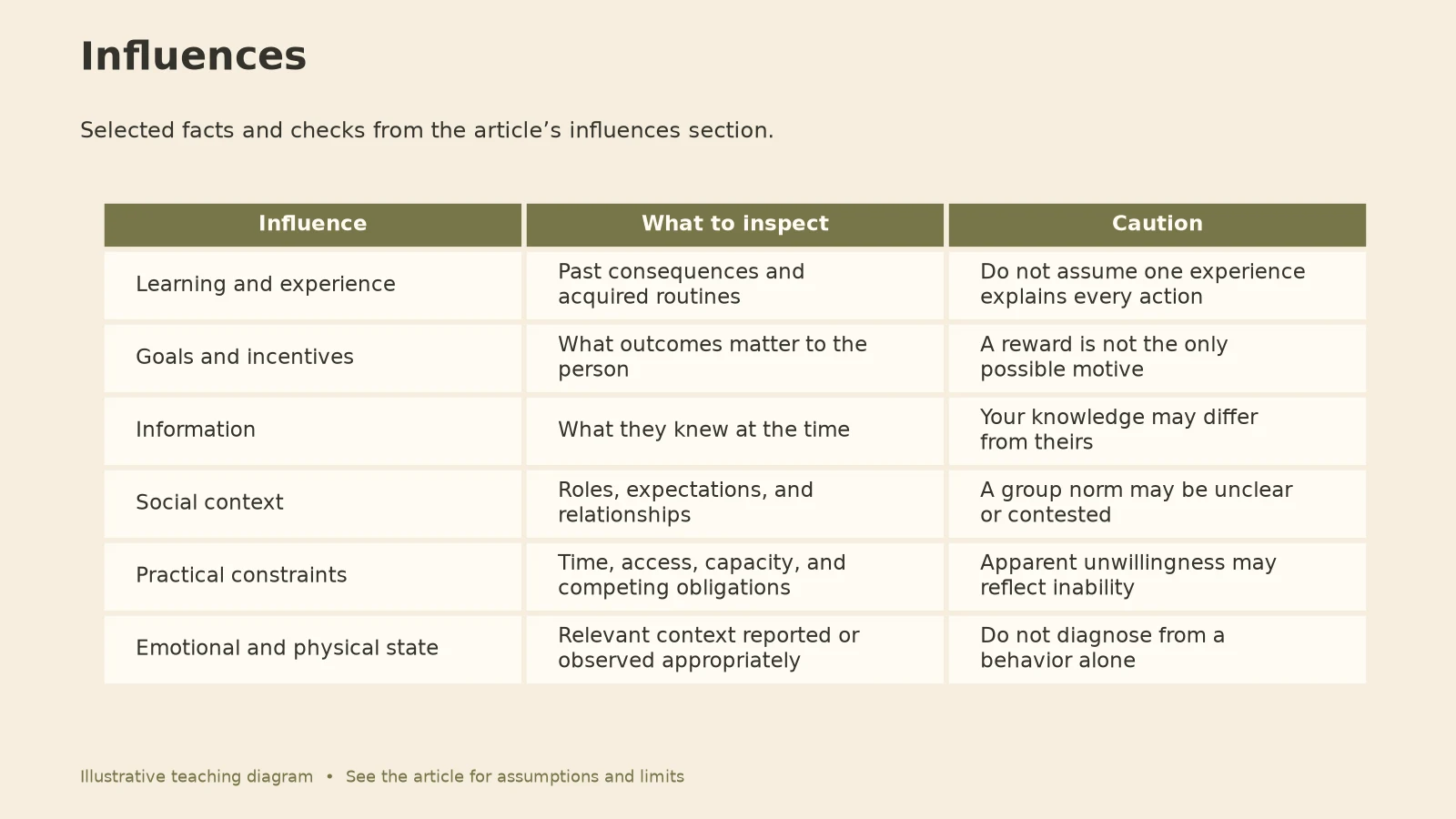
| Influence | What to inspect | Caution |
|---|---|---|
| Learning and experience | Past consequences and acquired routines | Do not assume one experience explains every action |
| Goals and incentives | What outcomes matter to the person | A reward is not the only possible motive |
| Information | What they knew at the time | Your knowledge may differ from theirs |
| Social context | Roles, expectations, and relationships | A group norm may be unclear or contested |
| Practical constraints | Time, access, capacity, and competing obligations | Apparent unwillingness may reflect inability |
| Emotional and physical state | Relevant context reported or observed appropriately | Do not diagnose from a behavior alone |
The table is an original observation guide, not a complete theory of behavior. Influences can interact. A learned routine may fit one context but fail when the schedule changes.
OpenStax’s account of learning describes changes in behavior or knowledge through experience. For a more focused account of rewards and motivation, see incentive theory.
Worked example
A hypothetical volunteer repeatedly arrives late to a weekly meeting. The group considers three possibilities: the invitation time is unclear, the participant has a competing commitment, or punctuality is not strongly rewarded in the group’s routine.
Start with the records. Which meetings were late? Were there on-time exceptions? Did the meeting time recently change? Is the calendar invitation consistent with the written message?
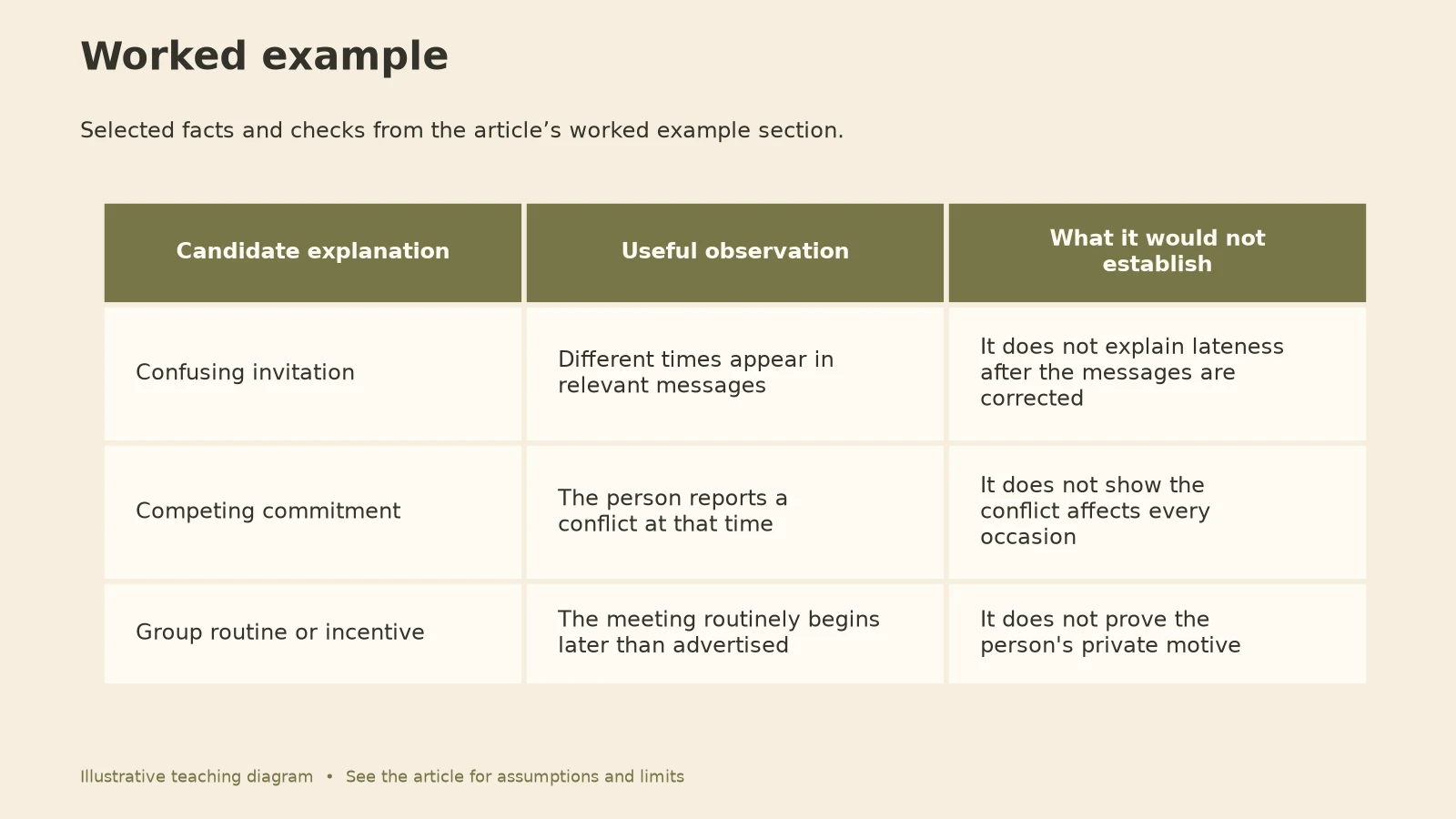
| Candidate explanation | Useful observation | What it would not establish |
|---|---|---|
| Confusing invitation | Different times appear in relevant messages | It does not explain lateness after the messages are corrected |
| Competing commitment | The person reports a conflict at that time | It does not show the conflict affects every occasion |
| Group routine or incentive | The meeting routinely begins later than advertised | It does not prove the person’s private motive |
The group can first clarify the time and ask about practical constraints. That action is useful and proportionate without requiring a theory of the participant’s personality.
If the pattern continues, review what changed and what remained. The conversation may reveal a need for a different schedule, a clearer responsibility, or a boundary around participation. Avoid turning the first plausible explanation into a permanent verdict.
The Hanlon’s razor guide helps check benign explanations without excusing repeated harm. The confirmation-bias guide helps avoid noticing only evidence that fits an existing impression.
Observation guide
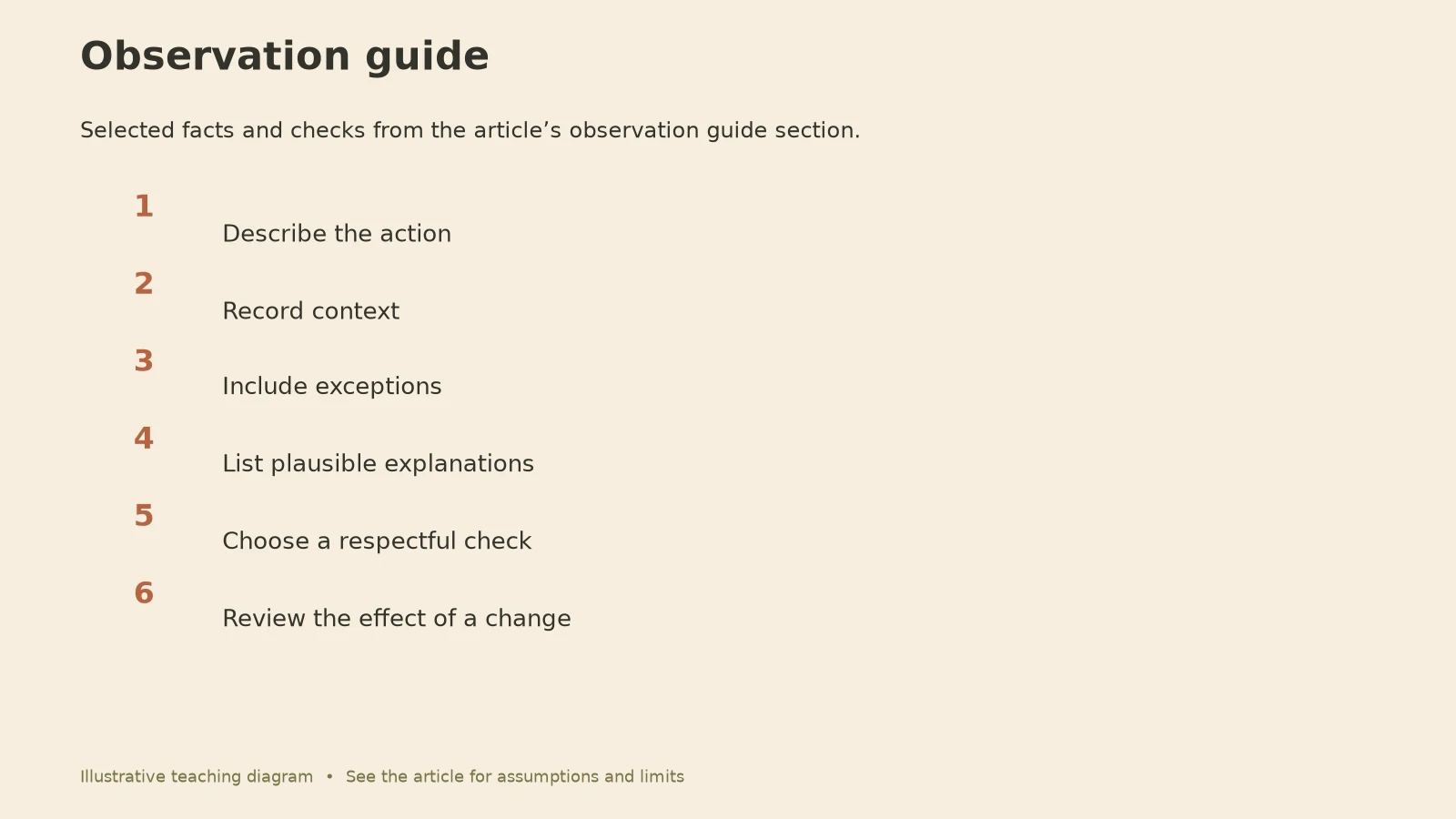
Use this original log for a recurring behavior:
- Describe the action. Use observable terms and a relevant time period.
- Record context. Include information, constraints, and what happened before and after.
- Include exceptions. Cases where the behavior did not occur can be informative.
- List plausible explanations. Separate observations, reported experiences, and speculation.
- Choose a respectful check. Ask a specific question or inspect appropriate records.
- Review the effect of a change. Consider alternatives and unintended consequences.
Keep privacy and relevance in view. Understanding a scheduling problem does not require collecting unrelated personal information. Ask about the practical issue the decision actually depends on.
A change in behavior after an intervention can be informative, but it does not automatically prove the proposed cause. Other circumstances may change at the same time. State the limits of the observation.
Do not use a short checklist to diagnose a mental-health condition, classify someone’s character, or infer a hidden intention. When a problem requires specialized assessment, ordinary observation is only part of the context.
For the wider way incentives and constraints interact, see behavioral economics and systems thinking. For evaluating the reasoning behind an explanation, see critical thinking.
Questions
Is human behavior predictable?
Some patterns can be studied under specified conditions, but a brief observation does not make an individual action certain. Context, information, learning, and changing goals matter.
Does a reward explain every action?
No. People can value an activity itself, relationships, responsibilities, and other outcomes. Practical constraints can also limit what they do.
How can I avoid judging too quickly?
Describe the behavior first, include normal cases and exceptions, and ask what evidence would distinguish plausible explanations. Acknowledge what you cannot infer from the action alone.