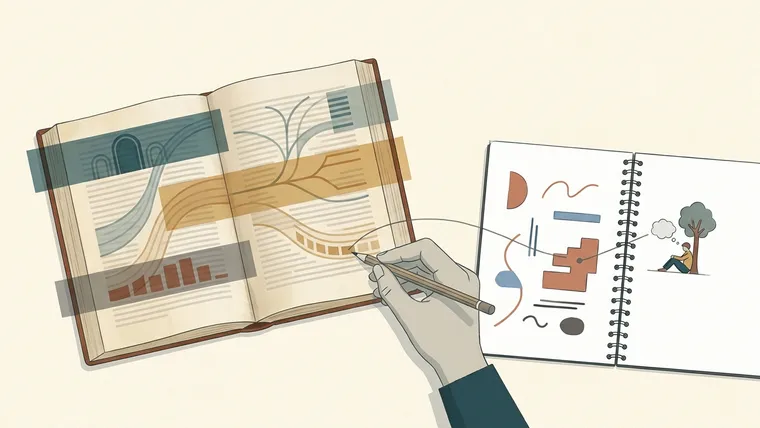
When studying a novel, you can use colors to find passages by the job they do: yellow for jokes and memorable bits, green for feeling present in a scene, blue for characterization, red for a character’s special advantage, and purple for what the reader is waiting to see. Other useful passages can simply be underlined.
This is one possible labeling system. The colors help retrieve a passage; a colorful page still leaves the writing problem open. You need an explanation you can test in your next scene.
To study novels to improve your writing, connect each note to three questions: what did the writer choose, what did it do to the reading experience, and how could you try that choice in a different situation?
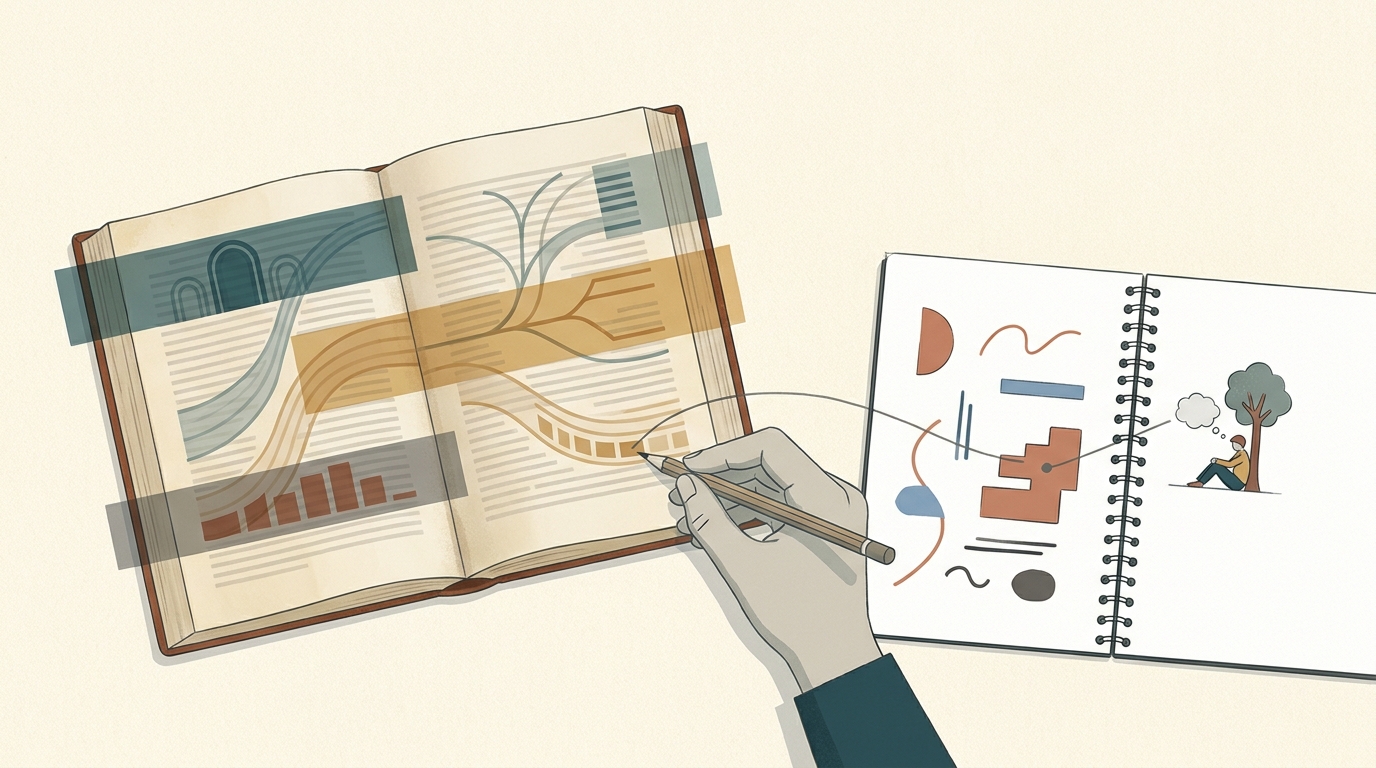
A reading note is carried into a new piece of writing.
Start with the effect you wanted to understand
A passage can be beautiful in several ways at once. Trying to record all of them makes analysis difficult to use later.
Choose something that connects to a problem in your own draft. Perhaps a conversation becomes tense without anyone raising their voice. Perhaps an ordinary room becomes a place you would miss. Perhaps a chapter makes you keep reading even though very little has happened yet.
Look at tone and the feeling a story gives the reader. A protagonist’s attitude toward an event changes the experience of following it. A familiar person, place, or small routine can make a later loss matter. Those effects are worth examining alongside striking sentences.
In this labeling system, green marks the details that let you feel present in a scene. A familiar activity or an unremarkable exchange may help more than another vivid description. Highlighting only the lines that sound impressive can miss the sentences holding the scene together.
Give a passage a question before adding more marks. “How did the room become familiar?” will lead to a more useful note than “Great description.” You can return to other qualities on another reading, if you still need them.
Pause before the answer, then compare your guess
Stop before the next passage, predict what you would write, then compare that prediction with what the author actually writes.
Choose a place where something could turn: a question has been asked, a character has noticed a detail, or a scene seems ready to end. Cover the next paragraph and make a brief prediction. You are making your own reading visible, including the expectations the existing passage has produced.
Then read on. Did the author answer the question now, delay it, or give an answer that changed the question? Did you expect an explanation and get an action? Did a small reaction make you reconsider what a character wanted?
The difference gives you something to examine. It needn’t be a spectacular twist. Sometimes the author chooses exactly what you expected, and the satisfaction comes from the timing or the way it is expressed. Constant surprise would be a strange requirement for every kind of story.
Here is a short fictional example written for this exercise. Two people have finished a project and are discussing another one:
“Shall we work together next time?” she asked.
He squared the invoices on the table before replying. “Let’s settle the bill for this one first.”
Stop after the question and predict the answer. You might expect agreement or a refusal. The actual reply delays that decision and brings an unsettled payment into view. The observable choices are an action before the reply and an answer that raises another issue. You may infer tension about payment, while remembering that the action alone cannot establish every detail of the relationship.
For this example, separate the visible choices from possible interpretations:
| Observation in the passage | A possible effect to examine |
|---|---|
| He squares the invoices before replying. | The delay may make the answer feel difficult to give. |
| Both the invoices and a request for payment appear in the passage. | The object gives the payment issue a concrete place in the scene. |
| He asks to settle this bill without answering whether they will work together again. | The reader may keep waiting to learn whether paying the bill will clear the way for another project. |
The second column is an interpretation. A different reader may react differently. Keeping that distinction lets you revise an explanation when the passage doesn’t support it.
Mike Bunn’s How to Read Like a Writer, published in 2011, offers a useful approach here: examine a writer’s choices, consider their effects, and think about alternatives. It gives the marks on a page somewhere to lead.
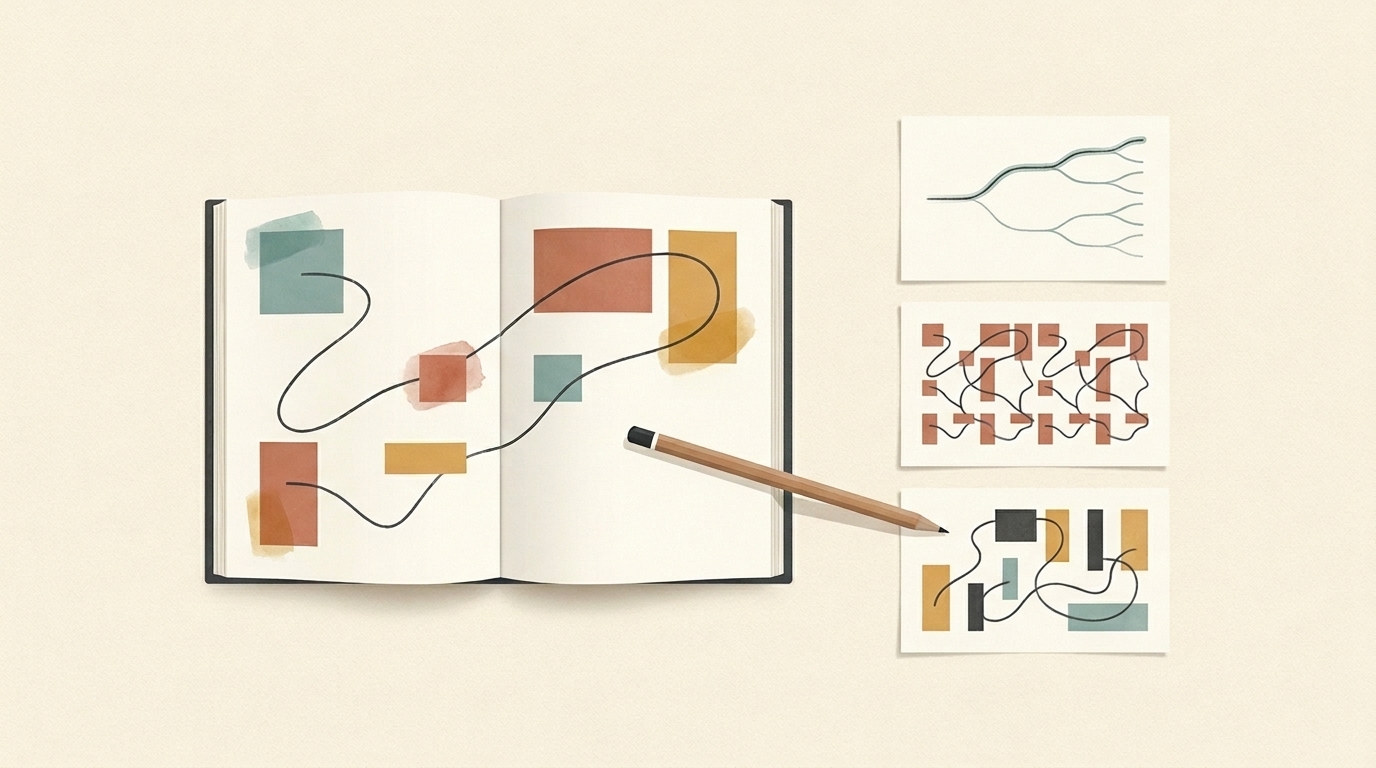
A few choices from the page, set aside for closer reading.
Give each color a job you can explain
Choose labels that help you retrieve a question you can act on. The five colors above are only one way to arrange them.
Yellow marks a joke or a memorable bit. The next question is what prepared it: an expectation, a character’s attitude, a repeated detail, or the position of the line. Saving the punch line alone may leave out most of its construction.
Blue asks how the passage makes someone recognizable. Does the person treat different people differently? What do they avoid saying? Can you recognize them from a choice before the narration supplies a description?
Red records a special advantage—a device sometimes called a “golden finger” in Chinese web fiction. The device matters through what it lets a character attempt and how it changes the reader’s expectations. A catalogue of powers would lose those connections.
Purple asks what I am waiting for. The passage may have promised a meeting, introduced a risk, or left a disagreement unsettled. I want to know how that expectation was established and what later passage carries it forward.
Green, as above, asks how I came to feel present. The underlined leftovers deserve another look too. A plain transition may keep a scene legible without advertising itself as a lesson in style.
Change the labels when they stop helping. Keep a short methods document organized around problems such as delaying an answer or making a place familiar. For each case, explain the choice in words you can understand later and attach your own attempt. You can merge or remove categories as your understanding develops.
Try the function in a different scene
Once you have an explanation, give it a test in your own writing. Keep the exercise small enough to finish.
If you studied a delayed answer, change the people, the setting, and what is at stake. Let someone do an ordinary action before replying, then examine whether the delay has a reason in that scene. Borrowing the device still leaves you responsible for the new passage’s motive and language.
If you studied familiarity before a loss, write a brief everyday scene in a new place. Choose details the characters would genuinely notice. Read it before adding the loss. Does the place mean anything yet? Extra adjectives may do little if the scene has given the reader no reason to care about being there.
These are exercises, so the result may be clumsy. Compare what you tried with what appeared on the page. A reader can help: ask what they noticed or expected before explaining the effect you intended. Their answer gives you information you would lose by supplying the interpretation first.
Keep source details with your study note. Use only the excerpt you need, respect copyright, and write the new scene in your own words. Private study doesn’t make copying someone else’s distinctive sentences into a publishable draft acceptable.
What reading research supports—and what it leaves open
A 2018 meta-analysis by Steve Graham and colleagues examined reading interventions and writing. It included 54 experiments with 5,018 students on reading instruction, and 36 investigations with 3,060 students on increased interaction with text. The results support the value of reading-related work for writing in the school settings studied.
Those studies don’t establish that an adult novelist will improve simply by reading a particular number of books. For this practice, the useful link is between something you notice and something you try. The attempt gives you a draft against which to check your understanding.
That also helps when using AI for analysis. You can ask it to point to the words supporting an interpretation and offer another plausible reading. Check that the words are actually there. A fluent account of “pacing” or “tension” can sound persuasive while staying detached from the passage.
Use material you are entitled to share, keep excerpts limited, and consider the tool’s privacy terms. You can describe the device in your own words or work with your own text. Uploading a whole copyrighted novel is unnecessary for studying one choice.
AI may help generate alternatives for an exercise. You still need to read the alternatives and write the version that fits your scene. Saving another analysis without trying anything would add to the same pile of notes.
Keep a small set of examples you return to
For a useful case, I want to retain the source, the question, the observed choice, my interpretation, and my own attempt. That is enough to revisit the lesson when a similar problem appears.
A collection of cases can be small. You can also remove an explanation when a later reading changes your mind. The document is allowed to become clearer through revision, just as a draft does.
If collecting has taken over, choose one passage and write a new paragraph that tries one of its devices. Turning a saved idea into an actual writing session gives more examples. To reserve time for the attempt, set a work interval and leave highlighting and sorting until afterward; a focus timer is one way to keep that interval visible.
And leave some reading alone. You can finish a chapter because you want to know what happens, without stopping to explain the machinery. When you come back to study it, there will be a real reading experience to remember: the moment you laughed, the answer you expected, the ordinary room you found yourself caring about.