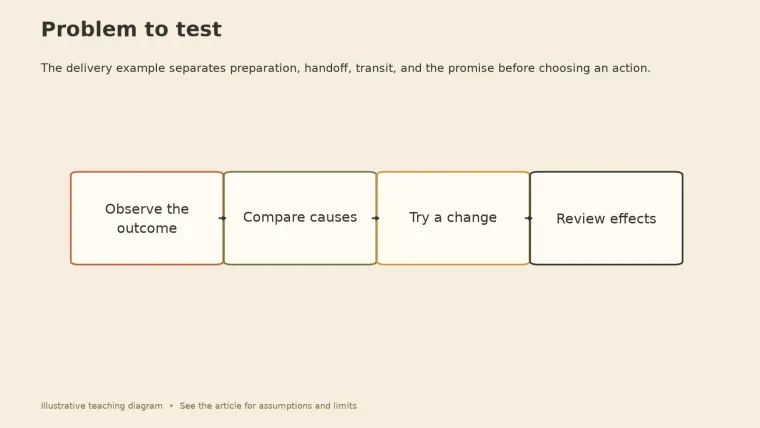
In the 1840s, women in labor at Vienna General Hospital begged not to be admitted to its First Clinic. From 1840 through 1846, its death rate from childbed fever was nearly three times that of the hospital’s Second Clinic. Some women gave birth in the street rather than risk it, and they rarely caught the fever. A young assistant named Ignaz Semmelweis wanted to know why.
Critical thinking and problem solving work together when you need to know what is wrong before deciding what to do. Critical thinking tests explanations against the evidence. Problem solving turns the surviving explanation into an action, tests it, and checks the result. Skip the first part and you can fix the wrong problem efficiently.
Semmelweis ruled out causes before he chose a fix
The problem was observable and specific. According to Irvine Loudon’s 2013 review in the Journal of the Royal Society of Medicine, maternal mortality from 1840 to 1846 was 98.4 per 1,000 births in the First Clinic, staffed by doctors and medical students, and 36.2 per 1,000 in the Second Clinic, run by student midwives. Same hospital, same city, same years.
That comparison did most of the early work. As his biography records, Semmelweis excluded overcrowding because the Second Clinic was always more crowded. He excluded climate because the two clinics were close together. He changed the position in which mothers gave birth, and he considered whether a priest’s last rites were frightening patients into illness. None of these closed the gap.
The break came in 1847. His friend and colleague Jakob Kolletschka was cut by a student’s scalpel during an autopsy and died of an illness that looked like the mothers’ fever. Semmelweis proposed that doctors and students were carrying “cadaverous particles” on their hands from the autopsy room to the delivery ward. That also explained the clinic gap: the midwives did not perform autopsies.
| Statement | Type | What Semmelweis did with it |
|---|---|---|
| First Clinic mothers die far more often | Observation | Compared clinic records across years |
| Overcrowding causes the fever | Candidate explanation | Rejected: the Second Clinic was more crowded |
| Birth position or fear of last rites causes it | Candidate explanations | Changed or examined them; the gap remained |
| Particles from autopsies travel on hands | Candidate explanation | Fit both Kolletschka’s death and the clinic difference |
| Washing in chlorinated lime will cut deaths | Prediction | Tested from mid-May 1847 |
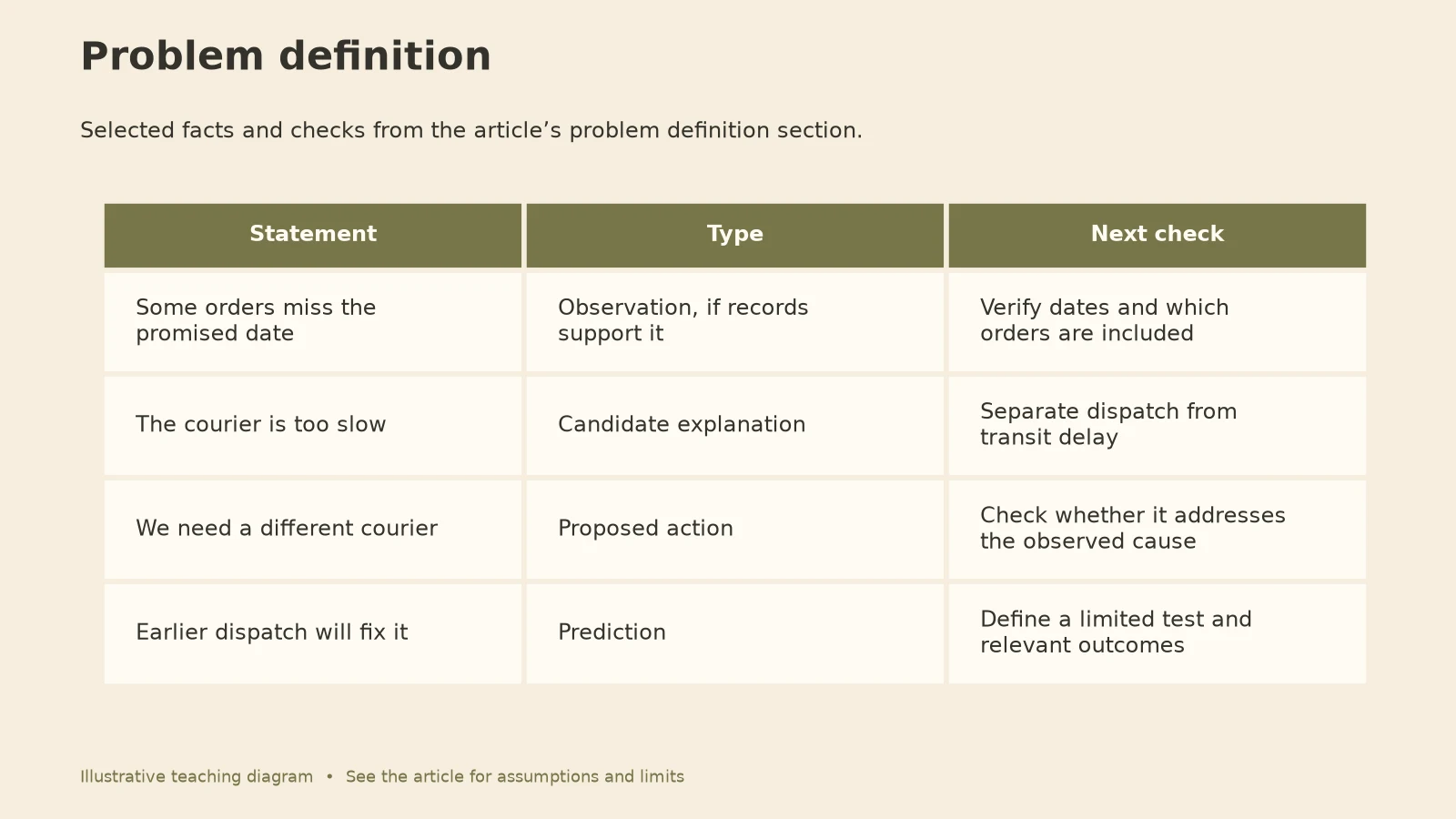
The table keeps an explanation from sneaking into the problem statement. “Mothers are dying more in one clinic” leaves room for several causes. “Doctors are killing mothers” would have started the argument at the end.
The same sort works on a modern complaint, such as orders arriving late:
The test worked, and the evidence still needed reading
In mid-May 1847, Semmelweis required students and doctors to wash their hands in chlorinated lime before entering the ward. Mortality in the First Clinic had been 18.3% in April. It was 2.2% in June, 1.2% in July, and 1.9% in August. In 1848, the First Clinic’s rate was 12.7 per 1,000 births, against 13.3 in the Second Clinic.
A before-and-after drop alone can mislead. Seasons change, staff rotate, and patient mix shifts. What made this result strong was the built-in comparison. The hypothesis predicted more than a fall in deaths: it predicted the First Clinic would converge with the Second, because the difference he had identified between them had been removed. That is what happened. This is the two-pass method at work: analysis finds the drop, evaluation asks what else could explain it.
| Field | Semmelweis’s test |
|---|---|
| Hypothesis | Material from autopsies, carried on hands, causes the excess deaths |
| Change | Chlorinated lime handwashing before entering the ward |
| Intended outcome | First Clinic mortality falls to the Second Clinic’s level |
| Comparison | The Second Clinic, where staff did no autopsies |
| What it could not show | The biological mechanism, which germ theory supplied decades later |
OpenStax’s chapter on problem-solving strategies separates algorithms from heuristics. Semmelweis had neither a formula nor a theory of germs. He had a sharp comparison and the discipline to drop explanations that did not fit it.
When problem solving backfires
Claiming more than the test showed. Semmelweis came to argue that childbed fever had essentially one cause, a lack of cleanliness. That position was extreme for its time and was widely rejected, even by doctors willing to try the washing.
Failing to make the case. He was slow to publish. When his book appeared in 1861, Loudon’s review describes it as clear in places and “bellicose” in others, full of attacks on critics. A correct fix that nobody adopts solves nothing outside your own ward.
Treating a fix as permanent. In Budapest, Semmelweis cut fever deaths dramatically. After he left, mortality under his successor rose sixfold. A solution that depends on a habit needs someone to keep it running.
Ignoring the system around the problem. Some doctors were offended by the suggestion that their hands could be unclean. Systems thinking helps when status, incentives, and routines push back against a change.
Your 5-minute problem card
Observable problem (no cause in the sentence):
Comparison group where it happens less:
What differs between the two?
Candidate causes I can rule out, and why:
Cause still standing:
Smallest reversible change to test it:
What result would match the cause? What would not?
Who keeps the change running?
If the fix depends on people repeating a behavior, set it up as a daily habit in Sweat and track it past the first good week.
Questions
Is critical thinking necessary for every small problem?
The checks can be brief. A familiar, reversible issue may need one observation and a simple adjustment. Save careful investigation for problems where a wrong explanation would be costly.
How do I stop analyzing and choose a solution?
Identify the uncertainty that could change the action. When more evidence is unlikely to justify its cost, take a proportionate step and set a date to look at the result. Decision-making frameworks help when several actions are on the table.
Was Semmelweis simply right while everyone else was foolish?
His 1847 observations were astute, but historians caution against the heroic version. Loudon argues that antisepsis in maternity hospitals spread mainly through Lister’s surgical methods, and that claims he abolished the fever are overstated.
What should I do if the first solution fails?
Inspect both the explanation and how the change was applied. A failed test tells you about that test. For the claim-checking skills behind this process, see critical thinking. For regular practice, see how to improve critical thinking.