In 2016, Stanford History Education Group researchers showed 203 middle school students a news site’s homepage. More than 80% believed a native ad labeled “sponsored content” was a real news story. A year later, the same group found PhD historians misjudging a website that professional fact checkers saw through. The difference was one teachable move.
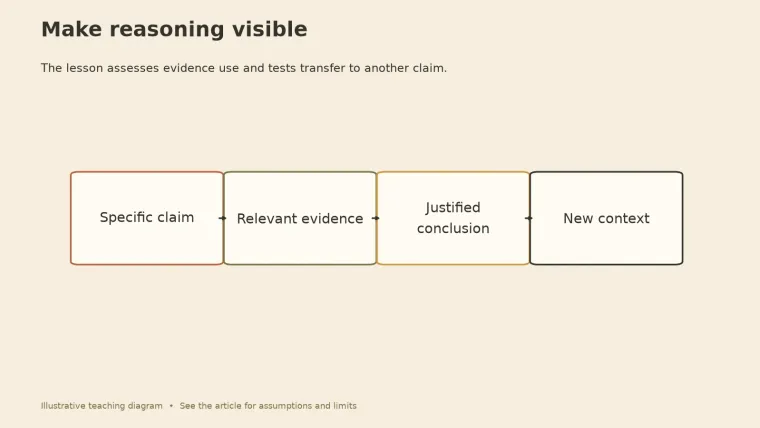
Teaching critical thinking works best when you teach specific, visible reasoning moves inside a subject learners understand, then practice them on new examples. Give learners a real claim, model one check aloud, ask them to justify a conclusion and say what could change it, and assess the reasoning rather than whether they agree with you.
Smart readers failed by reading carefully
The 2016 report, Evaluating Information: The Cornerstone of Civic Online Reasoning, collected 7,804 student responses to 56 tasks across 12 states, from middle school to college. The sponsored-content result was one of many.
The follow-up study tested skilled readers instead. Sam Wineburg and Sarah McGrew observed 10 historians, 10 fact checkers, and 25 Stanford undergraduates as they judged websites. One task compared the American Academy of Pediatrics, the large professional body, with the American College of Pediatricians, a much smaller advocacy group. Fact checkers easily identified the second group’s position. Historians largely judged both sites reliable. Students overwhelmingly picked the advocacy group’s site as more reliable.
The historians and students did what school teaches: they read the page closely. Fact checkers left it. They skimmed briefly, then opened new tabs to find out who was behind the site. The researchers called this lateral reading.
Teach a move, then name it
“Think critically” is a weak instruction when learners do not know what good reasoning looks like. The historians were expert evaluators of sources, much of it in print. Those close-reading habits did not carry over to a web page built to look authoritative.
Daniel Willingham’s discussion of teaching critical thinking makes the same point from cognitive science: thinking skills depend on knowledge, and they transfer poorly across domains. A general checklist does not equip a student to evaluate an unfamiliar technical claim.
| Approach | What the reader does | What it tends to catch | What it tends to miss |
|---|---|---|---|
| Vertical reading | Studies the page itself: design, citations, tone | Internal errors and weak arguments | Who funds or runs the site |
| Lateral reading | Leaves the page to search the source | Agenda, reputation, and context | Errors inside a reputable source |
| Teaching both | Checks the source, then the argument | Most of the above | Claims beyond the learner’s subject knowledge |
Lateral reading is a named move with a visible behavior: open a new tab before you trust the page. A teacher can model it, watch for it, and assess it.
A 45-minute lesson plan
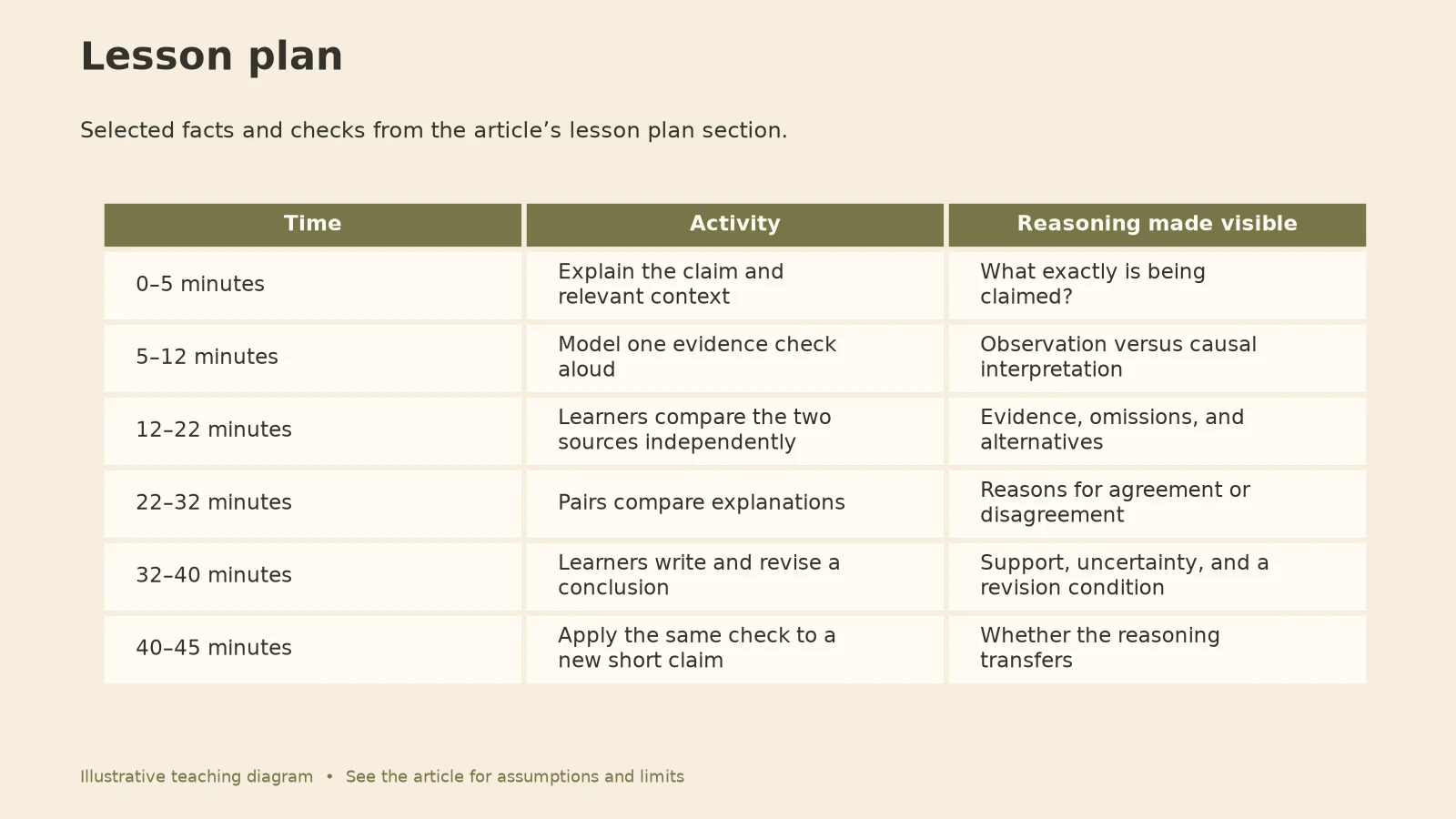
This lesson asks learners to judge which of two websites on the same topic is more trustworthy. Choose two real sites with similar names or a similar look, one from a broad professional body and one from a narrower advocacy group. Times are illustrative.
| Time | Activity | Reasoning made visible |
|---|---|---|
| 0–5 minutes | Explain the claim and relevant context | What exactly is being claimed? |
| 5–12 minutes | Model one evidence check aloud | Observation versus causal interpretation |
| 12–22 minutes | Learners compare the two sources independently | Evidence, omissions, and alternatives |
| 22–32 minutes | Pairs compare explanations | Reasons for agreement or disagreement |
| 32–40 minutes | Learners write and revise a conclusion | Support, uncertainty, and a revision condition |
| 40–45 minutes | Apply the same check to a new short claim | Whether the reasoning transfers |
In the model, avoid giving the answer. Show the move: “The page looks professional. Before I read further, I’ll open a new tab and search for who runs it.” Then show what the search reveals and how it changes your judgment.
Let pairs keep a disagreement the evidence does not settle. For adult training, use sources from the learners’ own field.
Assessment
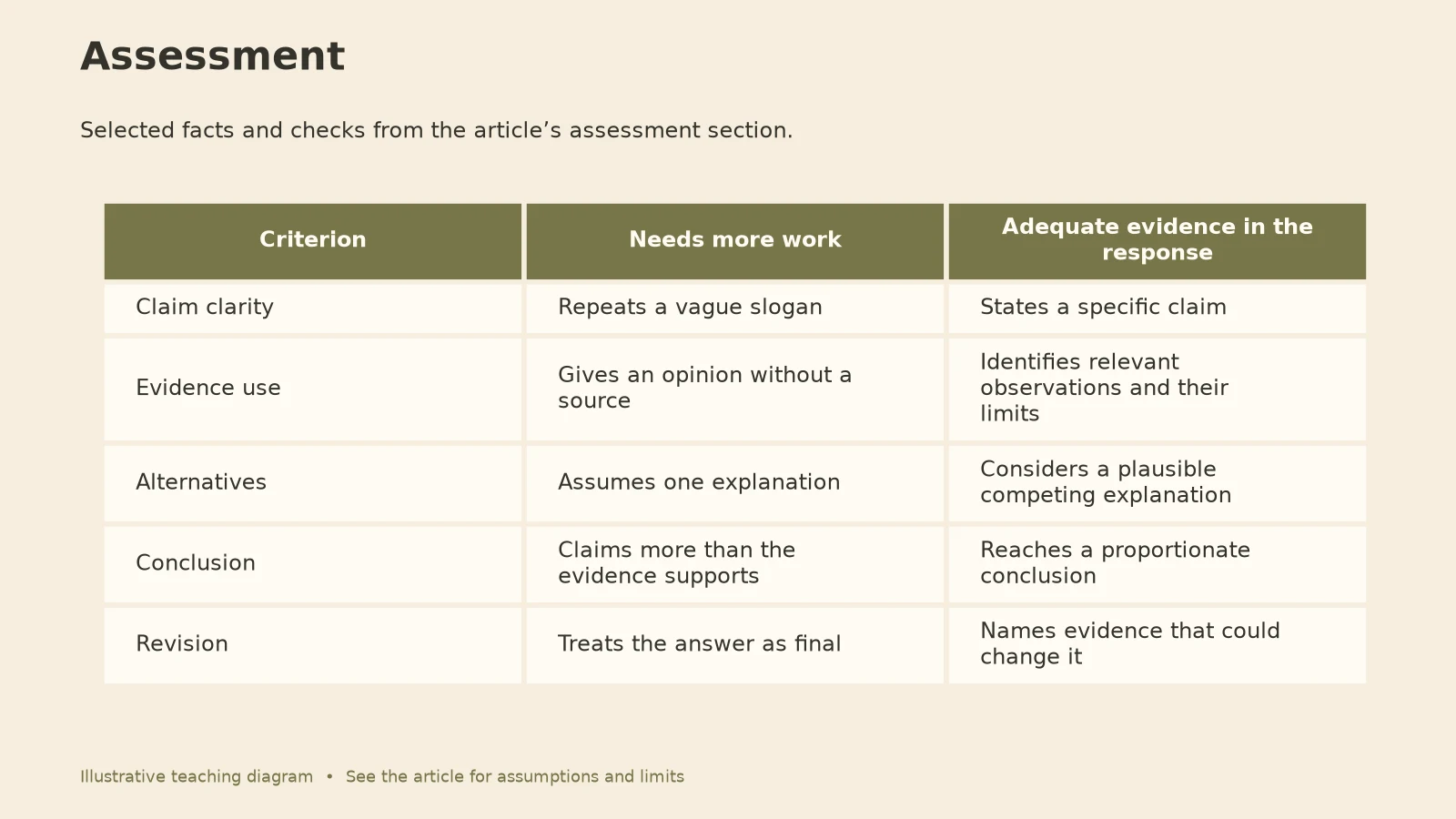
This original short rubric is a classroom aid, not a validated scale.
| Criterion | Needs more work | Adequate evidence in the response |
|---|---|---|
| Claim clarity | Repeats a vague slogan | States a specific claim |
| Evidence use | Gives an opinion without a source | Identifies relevant observations and their limits |
| Alternatives | Assumes one explanation | Considers a plausible competing explanation |
| Conclusion | Claims more than the evidence supports | Reaches a proportionate conclusion |
| Revision | Treats the answer as final | Names evidence that could change it |
Feedback should point to a reasoning move. “You noticed the polished design but did not check who publishes the site” helps more than “be more critical.” Keep disagreement separate from poor reasoning: a student may weigh uncertainty differently and still reason well.
Transfer takes more than one lesson
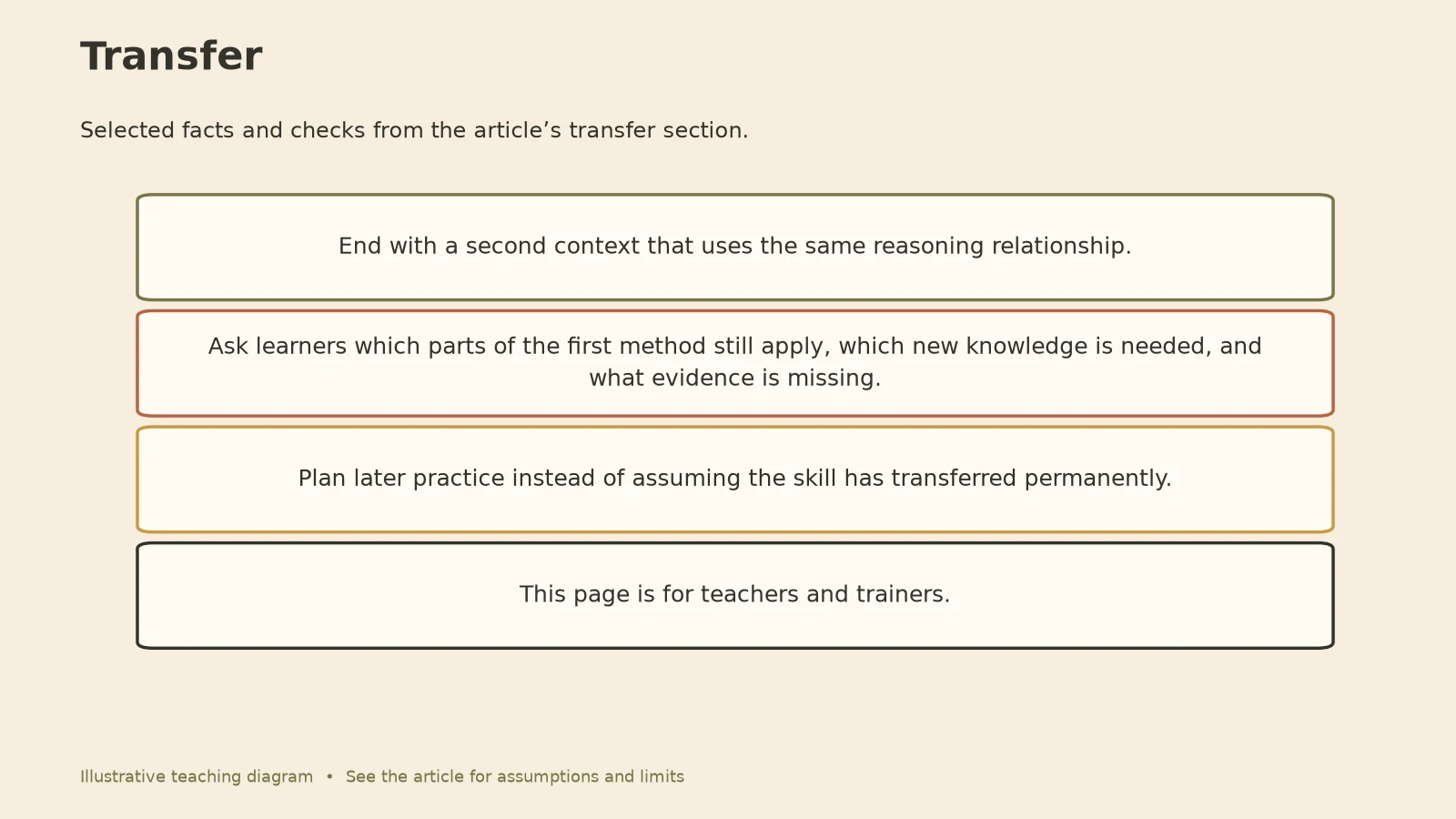
End with a second context that uses the same reasoning relationship. Move from two health websites to a viral post about a local policy, and provide enough facts to make the exercise fair.
Ask learners which parts of the first method still apply, which new knowledge is needed, and what evidence is missing. A learner who can recite “check the source” but never opens a new tab has not shown the skill.
Plan later practice instead of assuming the skill has transferred permanently. The research team’s 2022 district-wide field study trained teachers who then taught six 50-minute lessons on lateral reading in a required government course. Compared with 228 students in regular classrooms, the 271 students in those classrooms improved significantly in judging the credibility of digital content. Six lessons, with trained teachers, inside a required course.
When teaching critical thinking backfires
Teaching cynicism. If every lesson ends with “you can’t trust anything,” learners stop distinguishing a professional body from an advocacy group. The goal is calibrated trust.
Treating rubric scores as ability. A score depends on the task, the knowledge involved, and the judge. Avoid describing it as a learner’s general critical-thinking level.
Teaching the slogan without the knowledge. “Correlation is not causation” means little if a learner cannot name the competing cause in that subject.
Your 5-minute lateral reading drill
Page or claim:
Before reading: who runs this site? (new tab, search the name)
What do other sources say about them?
What does the page want me to believe or do?
Does what I found change how much I trust it?
One thing I still don't know:
For a warm-up, project an article from Daily Read and run the drill together, with learners taking turns choosing the search terms.
Questions
Can critical thinking be taught without subject knowledge?
General prompts help, but evaluating a claim needs knowledge relevant to it. The historians in the Stanford study had deep expertise in sources and still struggled online. Teach the needed context as part of the lesson.
How do I know whether the lesson worked?
Look for the move in a new task: does the learner leave the page, find out who is behind it, and explain how that changes the judgment? One good answer is evidence about that task, not proof of permanent improvement.
Where does this fit with other guides?
For definitions, see critical thinking. For individual practice, use how to improve critical thinking. For applying the process to a practical issue, see critical thinking and problem solving. For why learners favor the site that agrees with them, see confirmation bias.