During World War II, the statistician Abraham Wald worked on a data problem for the Statistical Research Group at Columbia University: how to judge which parts of a bomber were most vulnerable to enemy fire. The available evidence was damage on aircraft that came back from missions. Every recorded hit could be accurate, and the obvious reading could still point the wrong way.
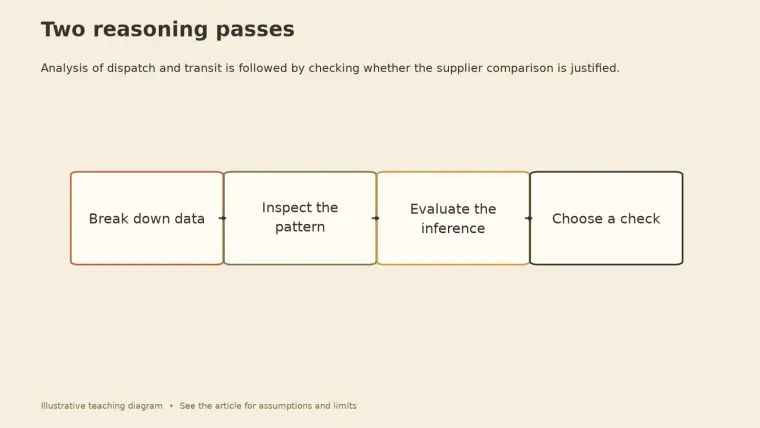
Critical thinking vs analytical thinking is the difference between examining information and judging what it proves. Analytical thinking breaks data into parts and finds patterns. Critical thinking asks whether the evidence, assumptions, and inference justify a conclusion. Most good decisions need both: analysis to see what the information contains, evaluation to decide what follows.
Counting the holes was the easy part
The analytical pass on the bomber data is straightforward. Sort the returning aircraft by where they were hit, tally the damage by section, and look for the parts that took the most fire. The natural recommendation is to add armor where the holes cluster.
The critical pass asks a different question: what sample produced these numbers? Every plane in the data survived. A plane hit in a truly vulnerable spot was less likely to return and be counted. So sections that show few hits on survivors may be the places where hits brought planes down.
According to Mangel and Samaniego’s 1984 review in the Journal of the American Statistical Association, Wald turned that insight into eight technical memoranda, totaling over 100 pages, on estimating vulnerability “using data obtained from survivors.” The work was used in World War II and later in Korea and Vietnam. As the survivorship bias entry notes, Wald proposed that his conclusions could guide where protective armor went.
The popular retelling compresses all of this into one line: armor the places without holes. Wald’s memoranda were far more mathematical than that, but the logic underneath is the same. The tally was correct. The conclusion depended on which planes were missing from it.
The comparison in one table
| Question | Analytical thinking | Critical thinking |
|---|---|---|
| Typical focus | Components, relationships, and patterns | Evidence quality, assumptions, and justified conclusions |
| Useful prompt | What parts make up this result? | Does this result support the claim? |
| In the bomber data | Tally hits by section of returning planes | Ask which planes never made it into the sample |
| Possible output | A breakdown, model, or comparison | A supported judgment with uncertainty |
| Common weakness if used alone | Precise analysis of unsuitable information | Broad skepticism without examining the details |
These are practical distinctions, not a standardized psychological classification. Different educational sources draw the boundary in slightly different places. The Foundation for Critical Thinking emphasizes evaluating evidence and reasoning, and OpenStax’s discussion of inference explains how observations and assumptions combine into conclusions.
Wald’s case also shows that critical thinking without analysis goes nowhere. “The data could be biased” is a shrug. Wald named the specific bias and then did the math to correct for it.
Run them in two passes, then repeat
Analysis exposes a pattern, evaluation spots a missing comparison, and another round of analysis tests it. This original two-pass worksheet keeps the loop explicit:
- Define the decision and claim. What are you trying to understand or choose?
- List the relevant components. Separate stages, categories, units, and comparison groups.
- Inspect the pattern. Record what the observations show before explaining it.
- Check the evidence. Examine source, method, completeness, and comparability. Ask who or what is absent from the data.
- Test the inference. Identify assumptions and plausible alternatives.
- Write a proportionate conclusion. State what follows, what does not, and the next check.
Step 4 is where the bomber problem turns. The same question applies to customer surveys (only people who stayed answer), success stories (failed founders rarely give talks), and performance reviews (people who quit are gone from the sample).
When the problem needs action, continue with critical thinking and problem solving. For choosing among methods, see decision-making frameworks.
When either one backfires
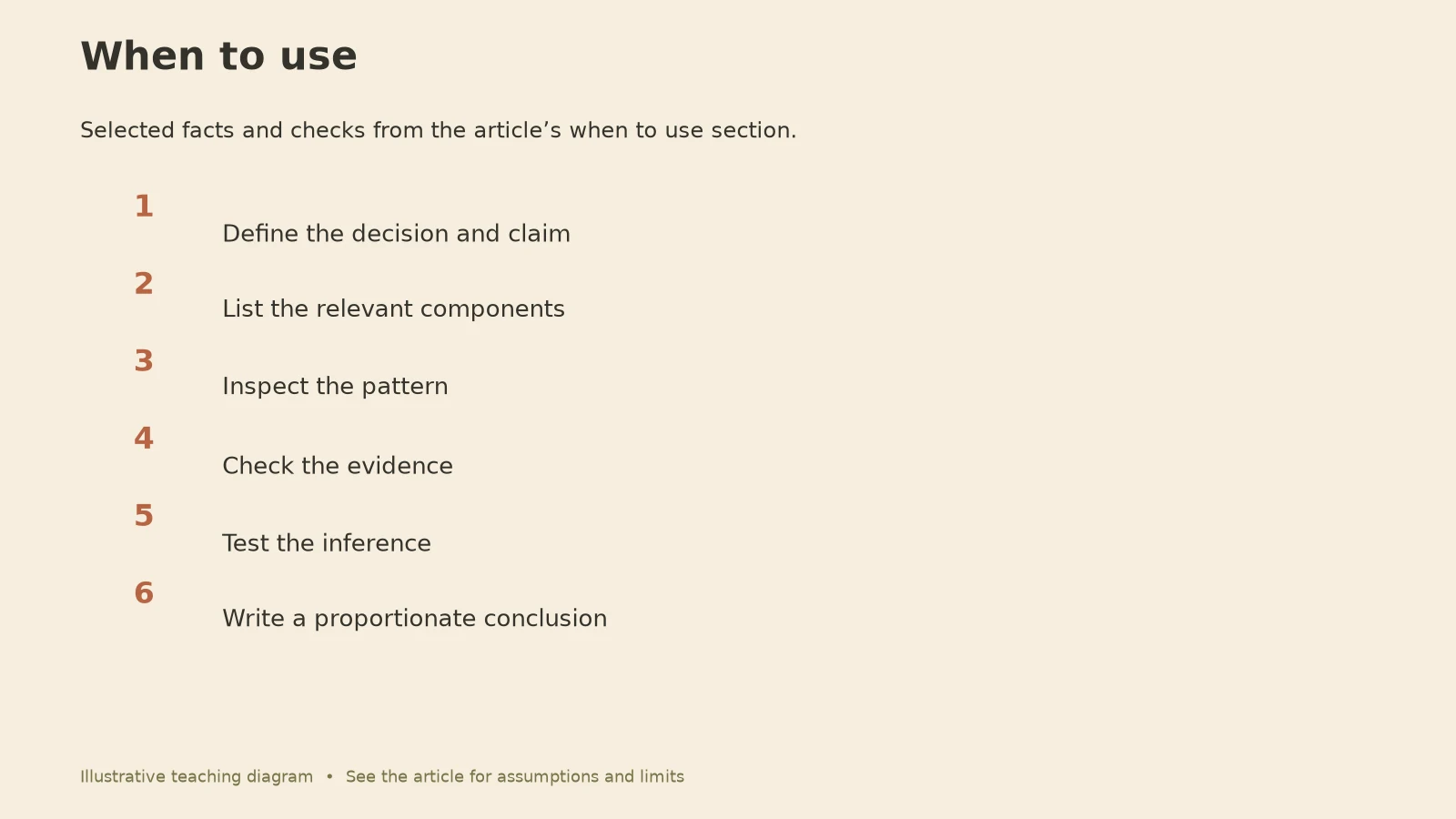
Treating analysis as automatic proof. A calculation inherits its inputs and assumptions. A perfect tally of survivors’ damage still describes survivors.
Treating critical thinking as disagreement. A well-supported claim can survive review. You do not need to reject it to show independence.
Treating the distinction as a ranking. Neither approach is universally superior. The task determines which checks are needed.
Turning labels into identities. “I am analytical; you are critical” can hide what either person actually does. Describe the method and output instead.
Overextending the task. A low-stakes, reversible choice may need one breakdown and one assumption check. Endless analysis spends resources without improving the action.
Domain knowledge still matters. Wald could spot the flaw and also build the estimation method. Someone who asks the right question but lacks the technical skill to answer it should bring in that expertise. The confirmation-bias guide helps when the analyst already favors one explanation.
Your 5-minute two-pass check
Claim or decision:
Analytical pass
  Parts I can break this into:
  Pattern the numbers show:
Critical pass
  Who or what is missing from this data?
  One assumption the conclusion depends on:
  One alternative explanation:
What I can conclude now:
Next check:
Paste the filled card into a prompt from Save Effort and ask it to argue that your sample is biased. Keep the objections that name a specific missing group.
Questions
Can someone use both at the same time?
Yes. Breaking down a problem and judging the resulting evidence often happen together. The distinction helps you find which part of the reasoning needs work.
Is analytical thinking only about numbers?
No. You can analyze an argument, a process, a text, or a set of interviews. The key is examining components and relationships.
Is survivorship bias part of critical thinking?
It is one of the most common things a critical pass catches. Whenever data comes only from cases that made it through a filter, ask what the filtered-out cases would show.
Which should I learn first?
Start with a concrete task and practice both moves: organize the information, then check what it justifies. For the full set of evaluation skills, see critical thinking. For daily practice, see how to improve critical thinking.