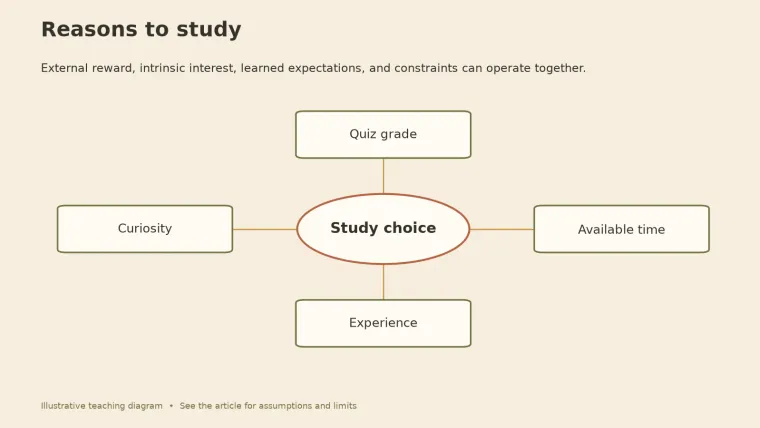
Incentive theory explains motivation in terms of anticipated outcomes that attract people toward an action or encourage them to avoid it. A grade, payment, recognition, or another valued consequence can influence what someone chooses. That does not mean rewards explain every action. People may also value the activity itself, have learned expectations, or face constraints that prevent a response. To examine an incentive, identify the behavior, the expected outcome, and why that outcome matters to the person. Separate external rewards from intrinsic interest, and check the actual behavior rather than assuming the incentive will work as intended.
Definition
A promised reward can change what an action seems worth doing. A student may study partly to receive a good grade; a volunteer may join partly for recognition or access to a useful experience.
The value of an outcome depends on the person and situation. A reward that matters to one participant may be irrelevant or inconvenient to another. An opportunity requiring unavailable time may not motivate action even if it is attractive.
OpenStax’s motivation chapter distinguishes intrinsic and extrinsic motivation and discusses several explanations of motivation. Incentives are one part of that wider picture, not a complete account of every behavior.
This page concerns motivation in psychology. The separate follow the incentives article examines institutional rules and who benefits from them.
Intrinsic and extrinsic
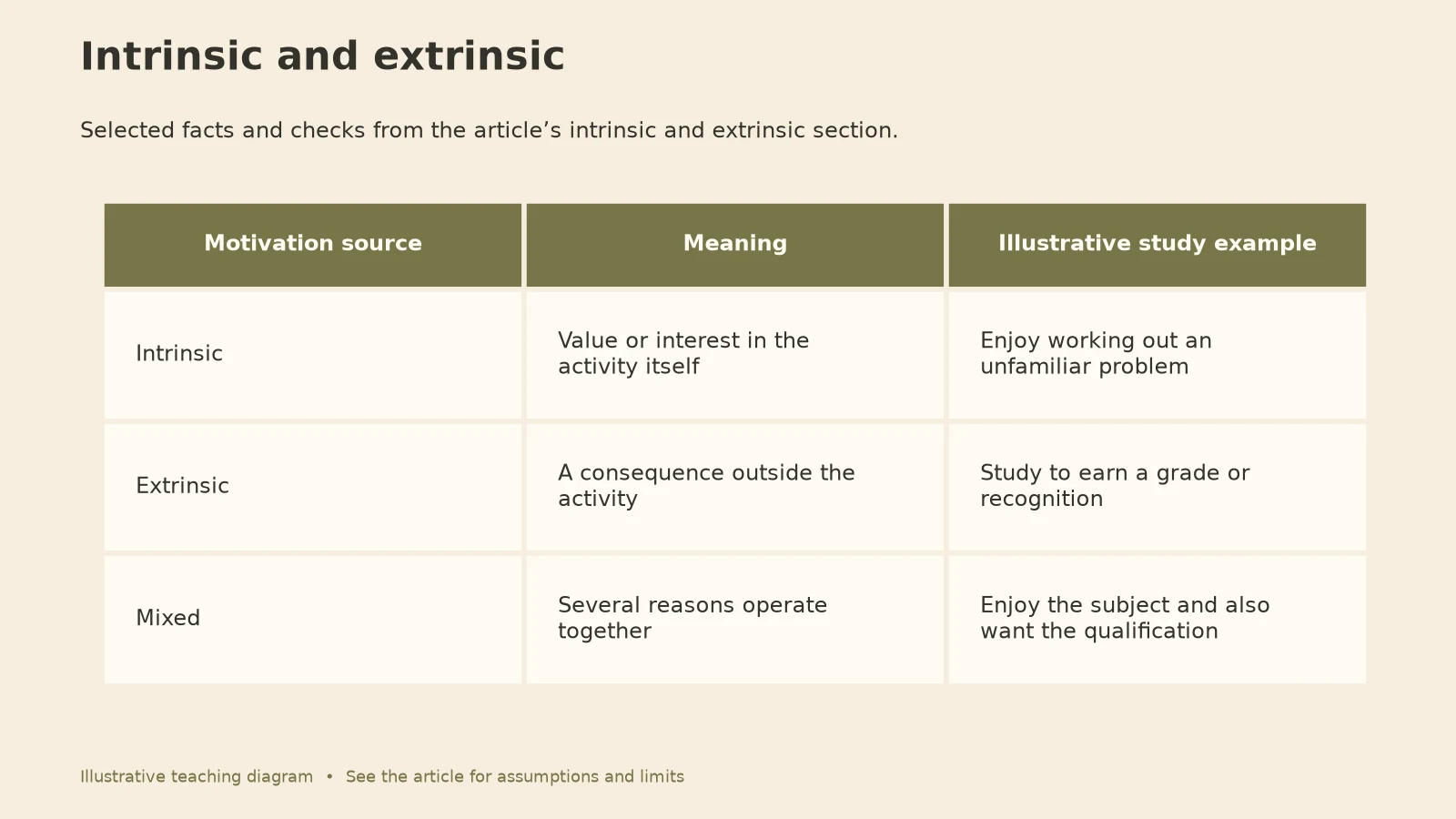
| Motivation source | Meaning | Illustrative study example |
|---|---|---|
| Intrinsic | Value or interest in the activity itself | Enjoy working out an unfamiliar problem |
| Extrinsic | A consequence outside the activity | Study to earn a grade or recognition |
| Mixed | Several reasons operate together | Enjoy the subject and also want the qualification |
The examples are hypothetical. An action can have more than one reason. Studying for a grade does not show that curiosity is absent, and enjoying a subject does not make a deadline irrelevant.
Rewards and consequences also operate within learned expectations. OpenStax’s account of learning describes changes through experience. What happened previously can affect what someone expects from the next action.
Avoid assuming that a reward will have the same effect regardless of how it is framed, delivered, or connected to the behavior. The expectation needs to be understandable, credible, and relevant.
Worked example
A hypothetical student has an upcoming quiz. They can spend an evening practicing the relevant material, reviewing unrelated interesting topics, or doing something outside study.
Their motivation might include the anticipated grade, curiosity about the subject, a wish to meet a commitment, and confidence from earlier successful practice. Constraints might include fatigue, missing materials, or insufficient time.
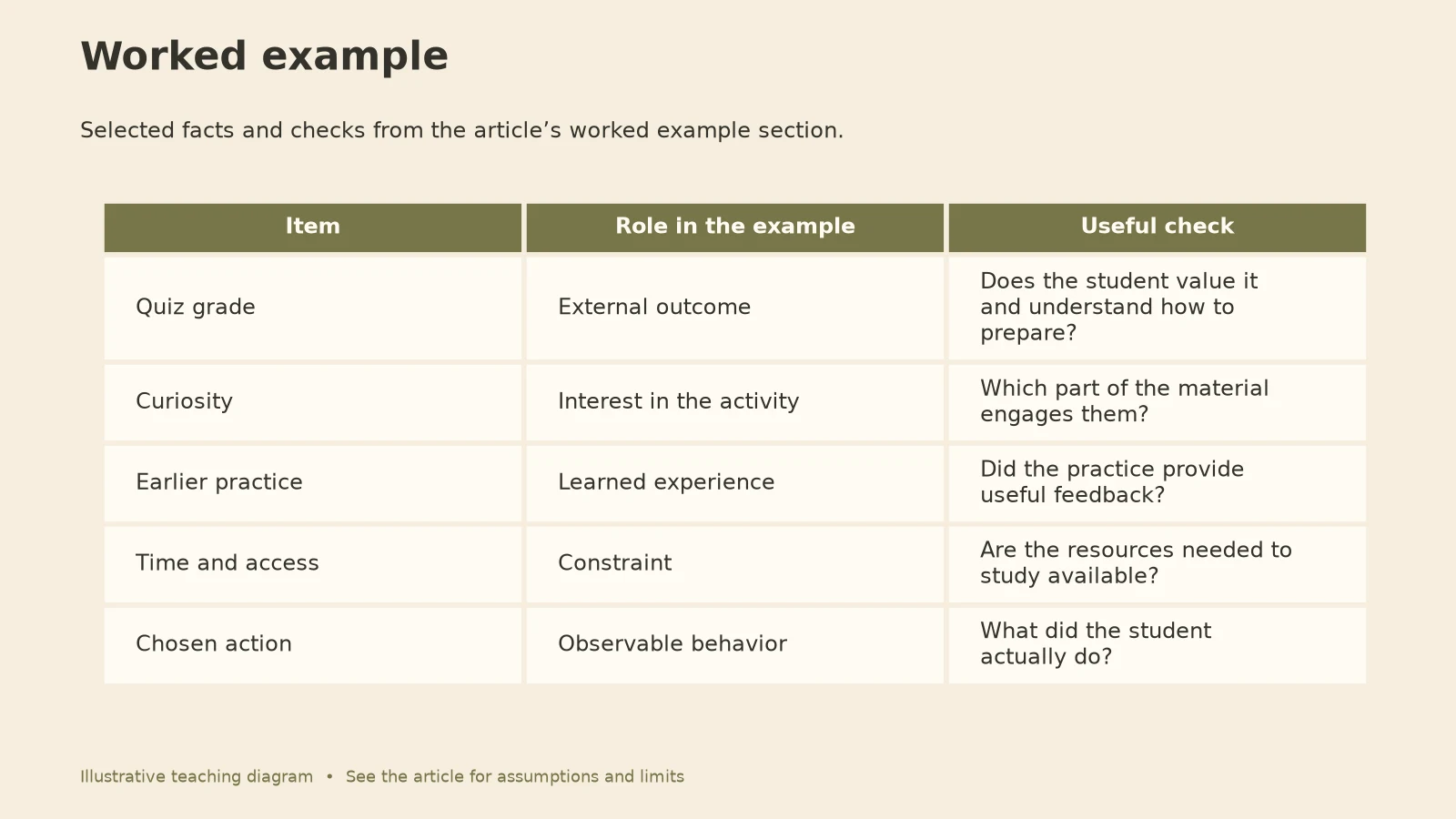
| Item | Role in the example | Useful check |
|---|---|---|
| Quiz grade | External outcome | Does the student value it and understand how to prepare? |
| Curiosity | Interest in the activity | Which part of the material engages them? |
| Earlier practice | Learned experience | Did the practice provide useful feedback? |
| Time and access | Constraint | Are the resources needed to study available? |
| Chosen action | Observable behavior | What did the student actually do? |
Adding a reward would not automatically solve a missing-materials problem. Increasing pressure may also shift effort toward memorizing likely quiz items rather than understanding the subject. That is a possibility to inspect, not a guaranteed response.
A proportionate action could be to provide clear practice material, explain what the quiz assesses, and give feedback. If a reward is used, evaluate whether the intended learning behavior changes and whether a different behavior is being substituted.
For teachers and trainers, see how to teach critical thinking, which shows how to make reasoning visible in a lesson. For individual practice, see how to improve critical thinking.
Limits
A reward is not a universal explanation of behavior. Several motives can conflict. People can misunderstand what is expected, distrust a promise, or be unable to act under the practical conditions.
Also distinguish an incentive from a conclusion about causation. If a behavior changes after a reward appears, other conditions may have changed. A careful account considers timing, context, alternatives, and how the behavior was measured.
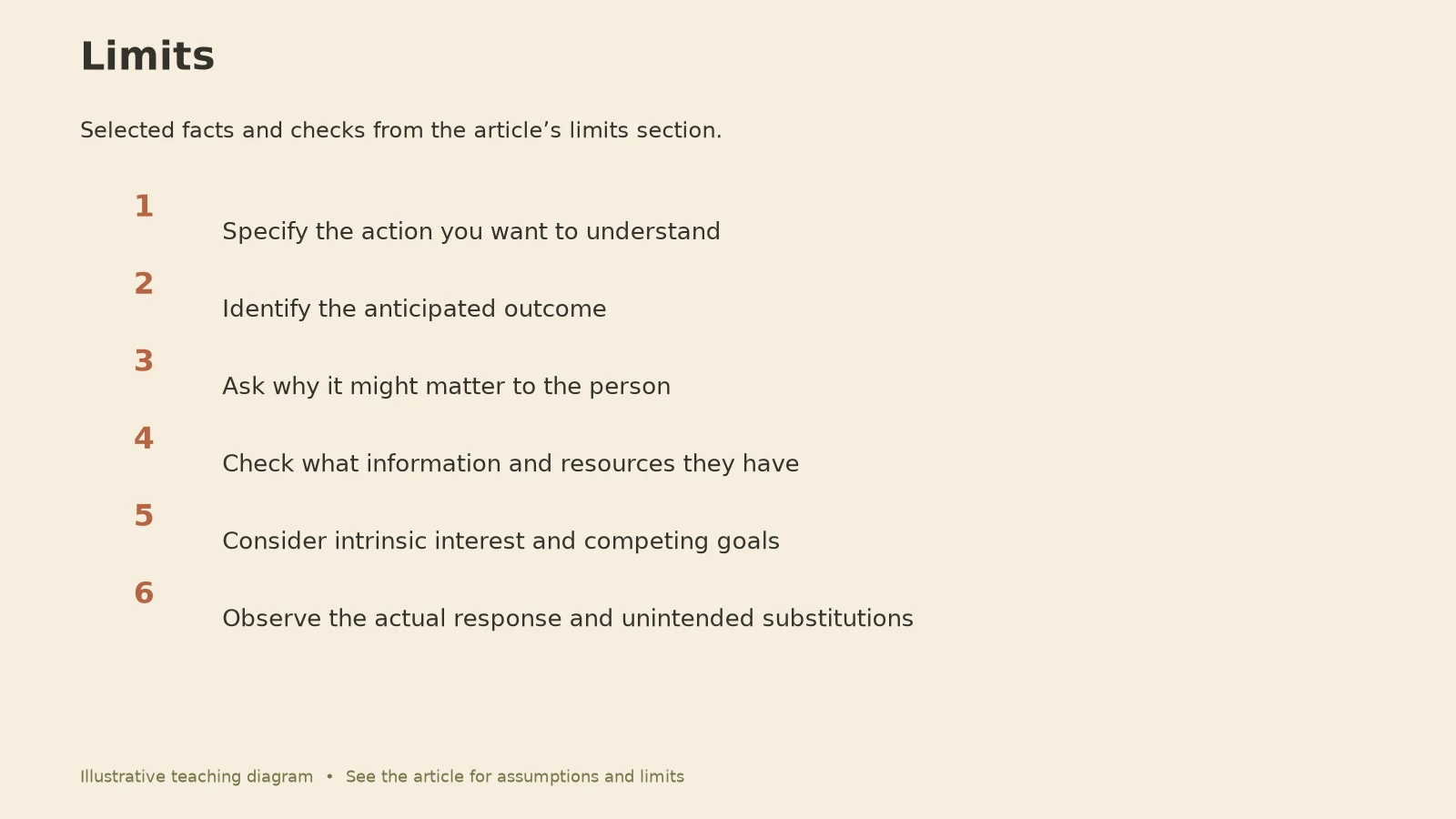
Use this original incentive-observation checklist:
- Specify the action you want to understand.
- Identify the anticipated outcome.
- Ask why it might matter to the person.
- Check what information and resources they have.
- Consider intrinsic interest and competing goals.
- Observe the actual response and unintended substitutions.
- Revise the explanation when the evidence does not fit.
For example, “the student did not study because they lack motivation” is too broad. “The student lacked the practice materials and could not identify what the quiz assessed” points to checks and possible actions.
The cobra effect explains a specific pattern where an incentive can worsen the intended problem. Goodhart’s law explains why a rewarded measure may become less informative. Those articles address institutional design, while this page keeps the focus on motivation and anticipated outcomes.
Questions
Is incentive theory only about money?
No. Recognition, grades, opportunities, avoidance of an unwanted outcome, and other valued consequences can influence action.
Can intrinsic and extrinsic motivation coexist?
Yes. Someone can enjoy an activity while also valuing its external results. Do not force a single-motive explanation when the context supports several.
Does a bigger reward always produce more motivation?
No universal relationship is established by the concept alone. Value, credibility, constraints, framing, and alternative goals matter. Check the response under the actual conditions.